What Is AI Integration? A Complete Guide for UK SMBs
Learn what AI integration means for UK SMBs, how it connects your CRM, website, email, invoicing and workflows, and where to start.
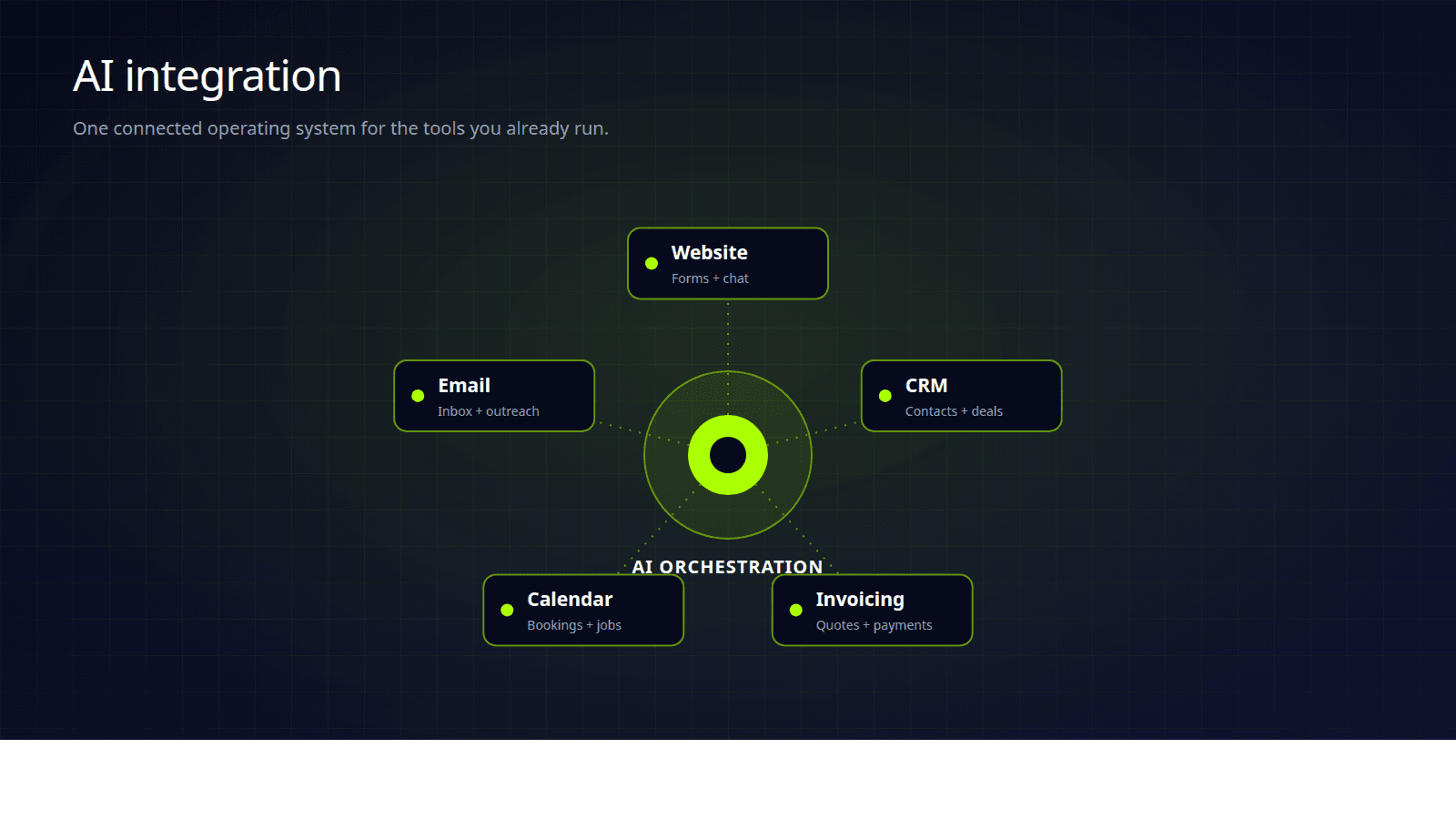
You have a CRM. You have an email platform. You have a website, an accounting tool, and a calendar that nobody updates properly. Each one holds a piece of your business, and not one of them talks to the others.
So your people do the talking for them. A lead fills in a form, and someone retypes it into the CRM. A deal closes, and someone else updates the invoicing. A customer asks where their invoice has got to, and three tools get opened before anyone can answer. This is normal. It is also a slow, expensive tax you pay every single day, and most of your competitors are still paying it too.
AI integration is how you stop paying it.
Here is the part the hype merchants skip over: buying an AI tool is not AI integration. Connecting that tool to the systems you already run, so data moves on its own and the AI can act on it, is. That distinction is the whole guide. Get it right and you claw back real hours every week. Get it wrong and you have bought a faster, more expensive way to make the same mess.
What AI integration actually is
AI integration is the process of connecting AI tools and agents to your existing business systems, your CRM, email, website, calendar and invoicing, so data flows automatically and AI can act on it in real time.
Think of it as a central nervous system for software you already own. Instead of each tool sitting on its own island, they are wired together. Instead of your team carrying data between them by hand, the AI does the carrying, the sorting, and the routing.
AI integration is not the same as buying an AI tool
This is where most SMB budgets quietly disappear, so it is worth being blunt about it.
An AI tool sits on top of your business. You open it, you prompt it, you close it. ChatGPT is an AI tool. It is genuinely useful, and on its own it changes nothing about how your systems work together.
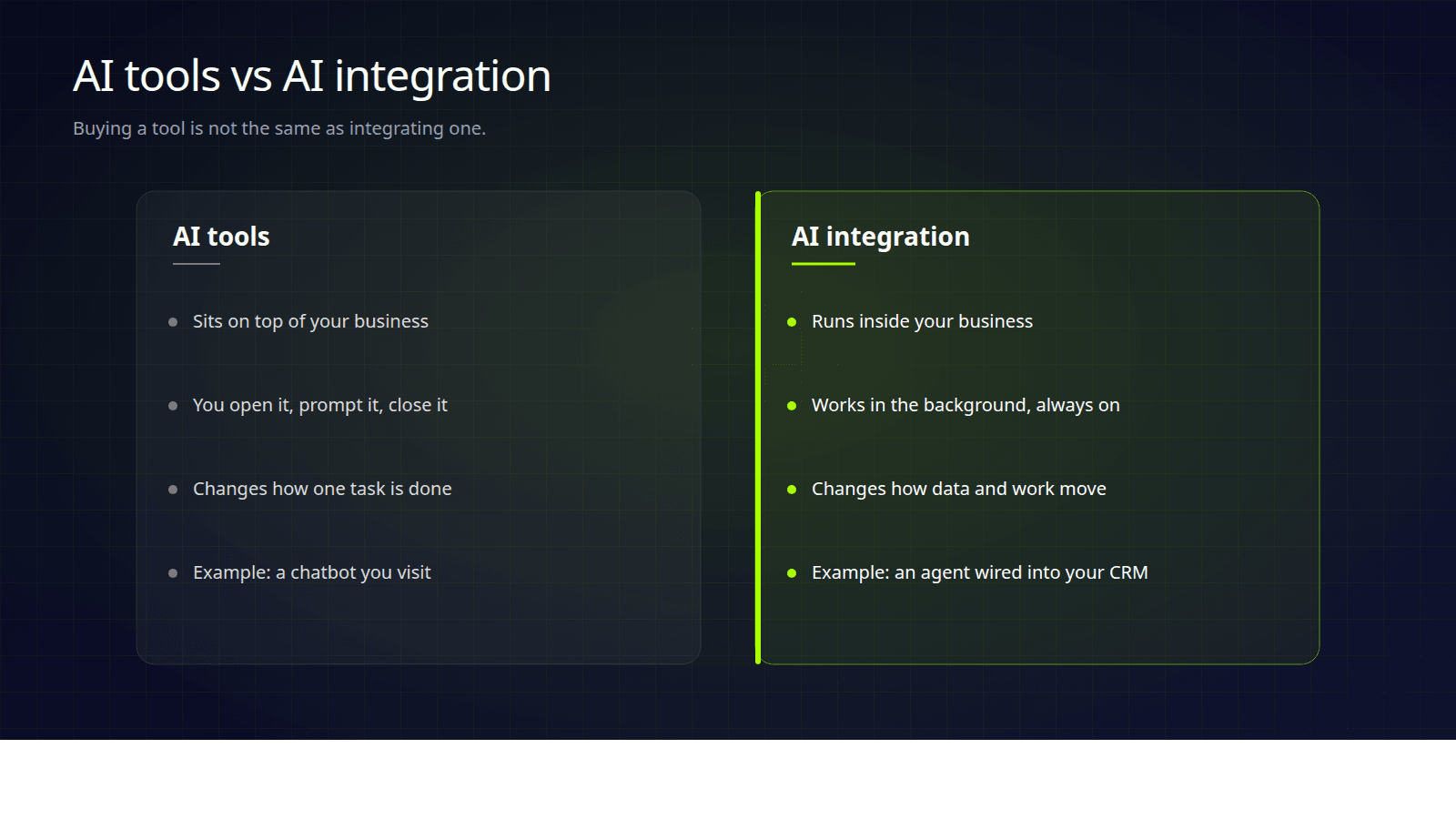
AI integration sits inside your business. It runs in the background, connecting systems and handling workflows without your team having to think about it. Connect an AI agent to your CRM so it qualifies leads, books follow-ups, and updates records by itself, and that is integration. The tool was never the hard part. Wiring it into how you actually work is.
Why UK SMBs are prioritising AI integration in 2026
The 2026 picture for UK SMBs is margin pressure, a tight labour market, and customers who expect an answer in minutes. You cannot hire your way out of that. Here is what is actually driving adoption.
Labour costs keep climbing
April 2026's National Living Wage rise pushed them up again. Handing repetitive manual work, the data entry, the lead routing, the follow-up email, to software is no longer a nice-to-have. It is margin protection.
Your competitors already started
Research from the Department for Science, Innovation and Technology puts AI use among mid-sized UK businesses at 68% in some form. If you are still copying data between tabs by hand, that gap is widening while you read this.
The tools finally earn their keep
The jump in capability from 2024 to 2026 is real. AI agents now run multi-step workflows with genuine reliability, not just one-shot prompts. That is what makes integration practical rather than theoretical.
Integration got cheaper
Pre-built connectors and mature APIs mean what used to take months of custom development now takes weeks, sometimes days.
What AI integration looks like in practice
Concepts are fine. Examples are better. These are ordinary UK SMB scenarios, not science fiction.
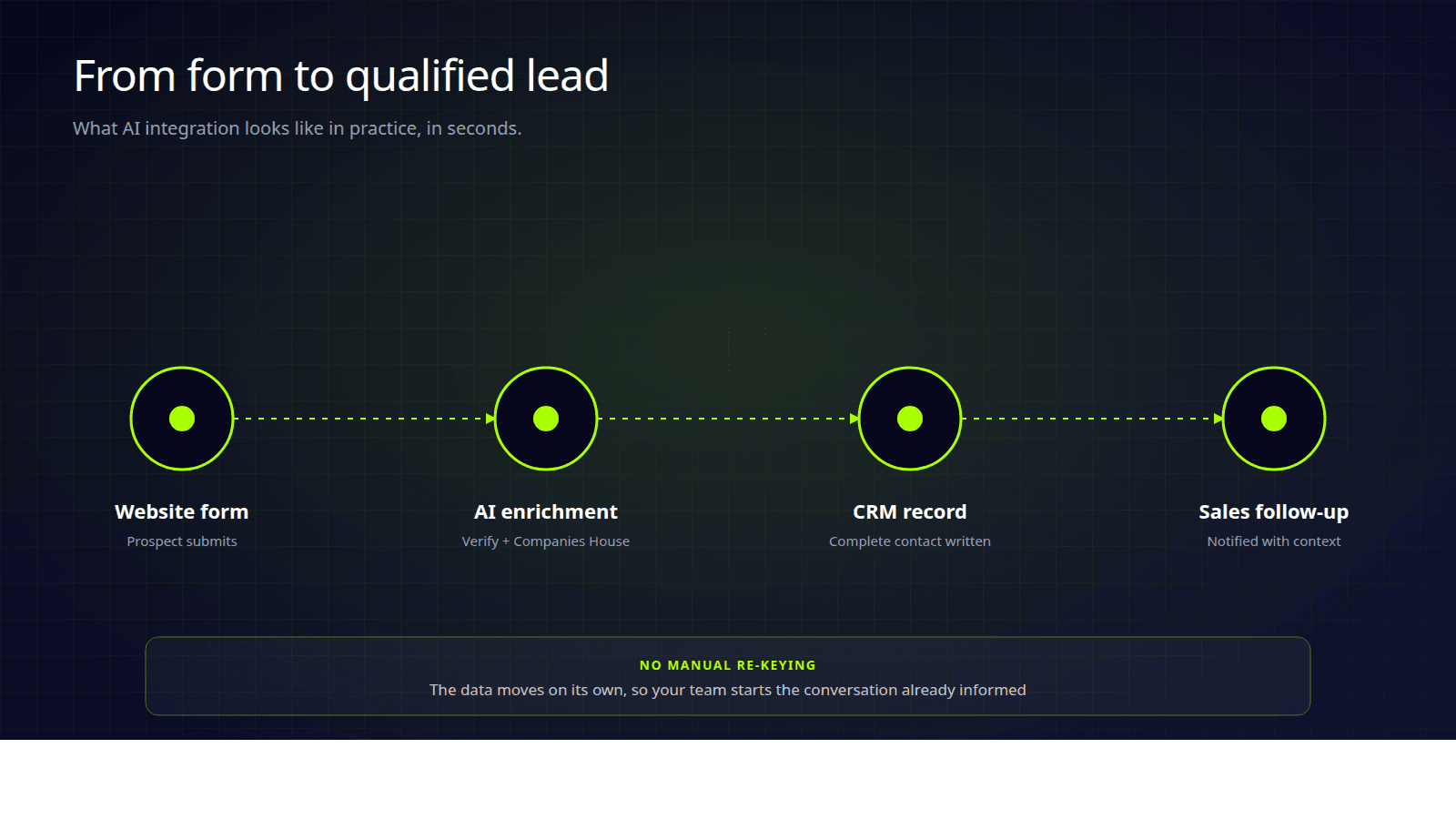
Lead capture to an enriched CRM record
A prospect submits your website form. Within seconds the AI verifies the email, checks the company on Companies House, finds the decision-maker, and writes a complete contact record into your CRM. Your salesperson gets a notification with context, not a bare form submission to go and chase.
Follow-ups that read like a person wrote them
Instead of a generic template, the AI drafts a follow-up from the actual conversation your team had: the right pain point, the right next step, sent at the right time. Your team approves it before it sends. No template stink, no hallucinated nonsense going out under your name.
Support triage that does not lose the plot
A customer emails a question or a complaint. The AI reads it, ranks it by urgency, searches your knowledge base, and either answers or drafts a reply for a human to check. Response time drops from hours to minutes.
Invoice chasing without the awkward phone call
The AI watches your aged debtors, sends polite but firm reminders, escalates on your rules, and flags the accounts that need a human. Your team stops nagging people for money and gets back to billable work.
The AI integration trap that eats SMB budgets
AI integration done badly is worse than no AI at all.
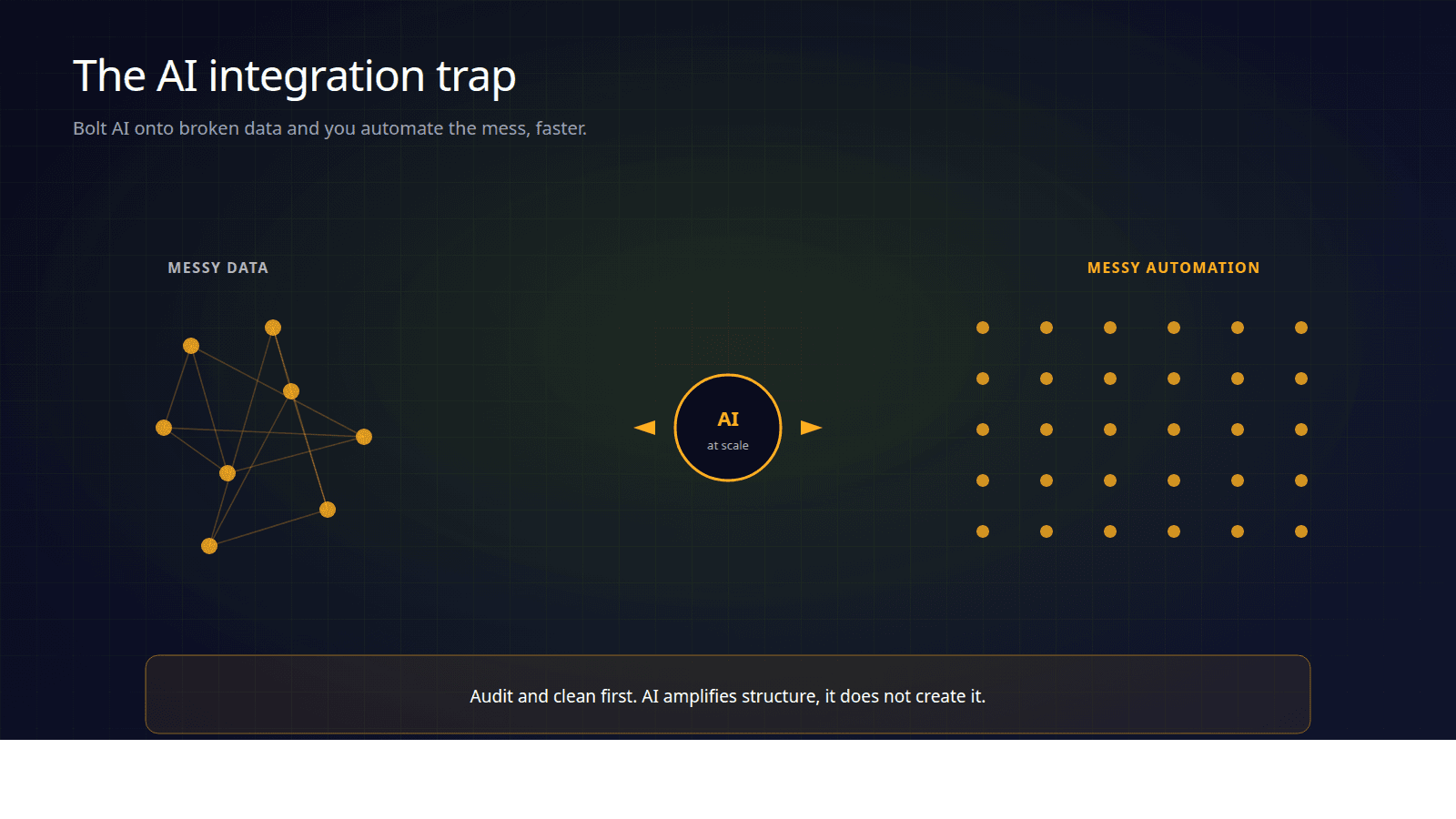
The most common mistake is bolting AI onto broken foundations. If your CRM is full of duplicate contacts, half-empty records, and three different spellings of the same company name, AI will not fix that. It will automate it, faster, at scale, and with total confidence. You will have built a machine for producing the same mess more efficiently.
Then there is the tool-first trap. A business sees an impressive platform on a webinar, signs up, and then cannot connect it to anything that matters. The demo was never the problem. Understanding your workflows, your data, and where the real bottleneck sits is the work, and it is exactly the work the hype skips, because it does not demo well.
Done properly, AI integration follows the same unglamorous, reliable pattern every time.
- Audit. Map how data moves between your systems today. Find the manual handoffs and the places errors creep in.
- Standardise. Clean the data. Fix the broken fields, remove the duplicates, agree on naming conventions.
- Integrate. Connect the systems with AI as the orchestration layer. It does not replace your tools, it makes them work together.
- Automate. Take the repetitive, rule-based jobs your team quietly hates and hand them to agents that run around the clock.
- Optimise. Review what is working, refine the rules, and expand to the next workflow as confidence grows.
What an AI integration consultant actually does
A good AI integration consultant does not start by selling you a tool. They start by mapping where your business actually loses time and money.
The bad ones do the opposite. They lead with a platform, a logo wall, and a list of features, then leave you to work out how any of it connects to the way you run. That is not consulting, it is reselling with extra steps.
A real AI integration consultant audits your systems and data first, identifies the one or two integrations that will pay for themselves quickly, and builds toward a system rather than a pile of disconnected tools. Our AI integration services are built this way. They are honest about what AI cannot do yet. They care more about your bottleneck than their tech stack. And they can show you, in hours saved or revenue recovered, why a thing was worth doing. If someone cannot draw that line for you, they are guessing with your budget.
How AI integration fits your wider AI strategy
AI integration is not a one-off project. It is one layer of what we call an AI Operating System, or AIOS: a practical framework for how AI, automation, and workflows are organised across your whole business. You can see the full picture of how these pieces fit together in our solutions overview.
For most UK SMBs the AIOS grows the sensible way. It starts with one high-impact, low-complexity integration, CRM automation, support triage, or lead qualification, that delivers a visible result fast. That result buys the confidence to go deeper. Over time your separate integrations connect to each other and become one system that quietly runs your operations. That is the difference between AIOS design and the AIOS integration work that brings it to life.
There is a reframe behind all of this worth sitting with. Every platform now ships the same automation. Execution is becoming commoditised, and close to free. When everyone has the same machine, the machine stops being the advantage. The advantage is what you feed it: your offer, your positioning, your data, and the system that connects a click to a qualified conversation to a closed deal. That system is an AIOS, and it is the thing actually worth building.
Where to start
If you run an SMB and you can feel that your processes could be smoother but you do not know where to begin, do not begin with a tool. Begin with the friction.
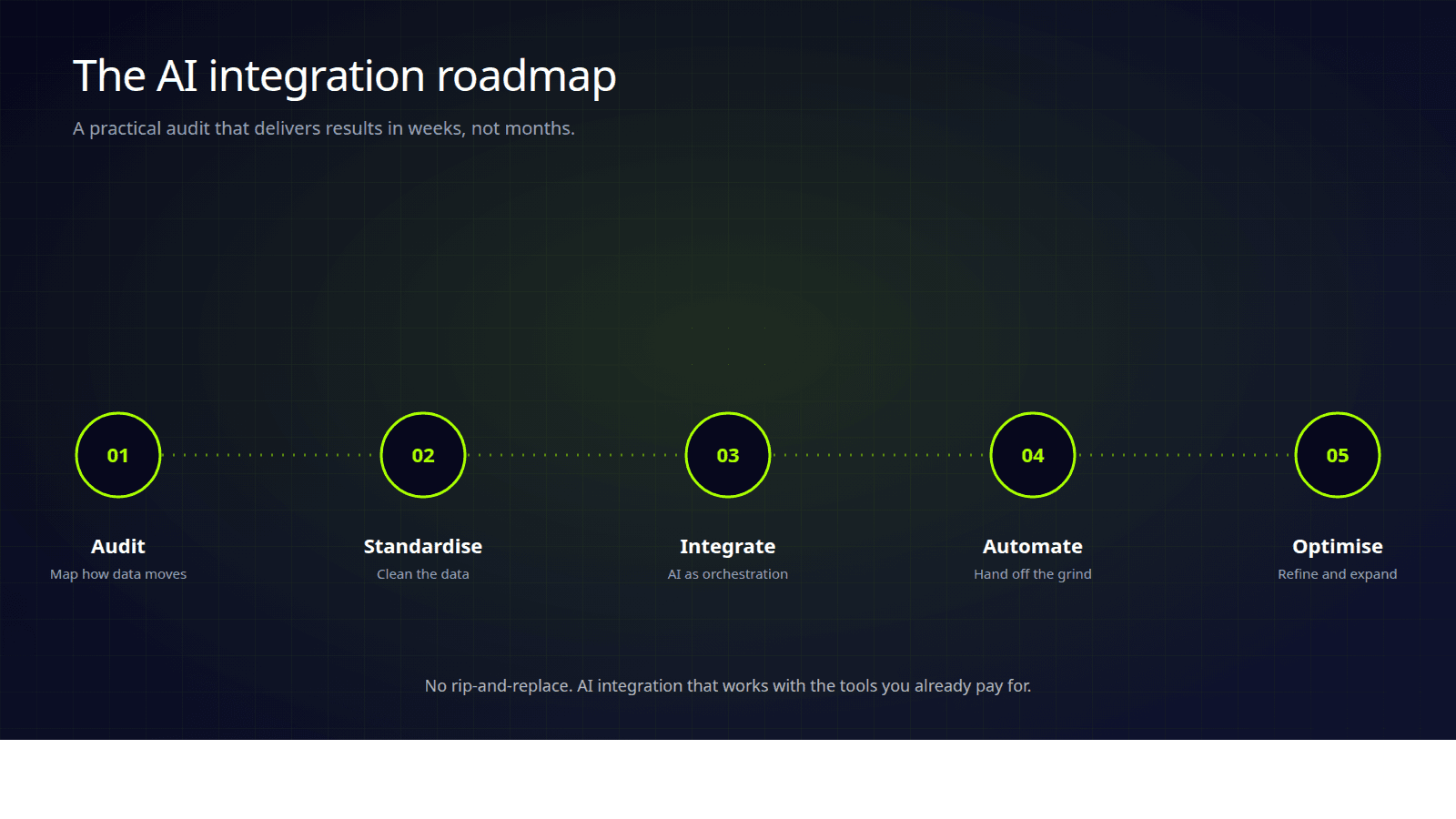
At Generativ we open every engagement with an AI integration audit: a practical review of your systems, your data, and your workflows. We find the highest-impact opportunities and build a roadmap that delivers measurable results in weeks, not months. No rip-and-replace. No six-month pilot that quietly dies in a shared drive. Just AI integration that works with the tools you already pay for.
If you would rather talk it through with an AI integration consultant than guess, book a free AI integration consultation and we will show you where AI will have the biggest impact on your business.
Book a free AI integration consultation
Find out where AI can have the biggest impact in your business, without ripping out the tools you already use.
Book a free AI integration consultation or get in touch and we will map the specific places where AI integration would move your commercial numbers.
Frequently asked questions
What is AI integration?+
AI integration is the process of connecting AI tools and agents to the business systems you already run, your CRM, email, website, calendar and invoicing, so that data flows automatically and AI can act on it in real time. Instead of your team carrying information between disconnected tools by hand, the AI does the carrying, sorting and routing in the background.
Is AI integration the same as buying an AI tool?+
No. An AI tool sits on top of your business: you open it, prompt it and close it, like ChatGPT. AI integration sits inside your business and runs in the background, connecting systems and handling workflows without your team having to think about it. Buying the tool was never the hard part. Wiring it into how you actually work is.
Why do AI integration projects fail?+
The most common reason is bolting AI onto broken foundations. If your CRM is full of duplicate contacts and half-empty records, AI will not fix that, it will automate the mess faster and at scale. The second is the tool-first trap, where a business buys an impressive platform it cannot connect to anything that matters. Auditing your workflows and cleaning your data first is the work that actually makes integration pay off.
How long does AI integration take for an SMB?+
Thanks to pre-built connectors and mature APIs, what used to take months of custom development now often takes weeks, sometimes days. A sensible approach starts with one high-impact, low-complexity integration such as CRM automation, support triage or lead qualification, which delivers a visible result fast and builds confidence to go deeper.
Where should a UK SMB start with AI integration?+
Start with the friction, not a tool. Map where your business loses time and money: unanswered enquiries, manual data entry, slow follow-up, invoices chased by hand. Generativ opens every engagement with an AI integration audit of your systems, data and workflows, then builds a roadmap that delivers measurable results in weeks. There is no rip-and-replace, the integration works with the tools you already pay for.
What does an AI integration consultant do?+
A good AI integration consultant starts by mapping where your business loses time and money, not by selling you a tool. They audit your systems and data first, identify the one or two integrations that will pay for themselves quickly, build toward a connected system rather than a pile of disconnected tools, and can show you in hours saved or revenue recovered why each step was worth doing.