The AI Operating System You Own, Not the One You Rent
Most enterprise AI pilots fail. The cause is an ownership failure, not a technology one, and it is why mid-market firms should build an AIOS they own.
The largest companies in the world have spent two years and tens of billions of pounds running an experiment in AI adoption. The results are now in, and they are bad. Understanding why they are bad is the most useful thing a mid-market firm can do before it spends a penny of its own.
This is not a piece about which AI tools to buy. It is about a decision that sits underneath that question and determines whether any of the tools will matter: whether your firm is going to rent its AI capability or own it. The enterprises that are failing are failing because they rented. The firms most able to avoid their mistake are not other enterprises. They are mid-market businesses, for reasons that are structural and worth setting out plainly.
The enterprises already ran this experiment, and most of them lost
Start with the headline finding, because it is stark. MIT’s Project NANDA, in its 2025 report The GenAI Divide, found that roughly 95% of enterprise generative AI pilots delivered no measurable impact on profit and loss. Not a modest return. Zero. The study drew on practitioner interviews and an analysis of more than 300 public deployments, and its conclusion was that only about one pilot in twenty crossed into scaled, profit-relevant production.
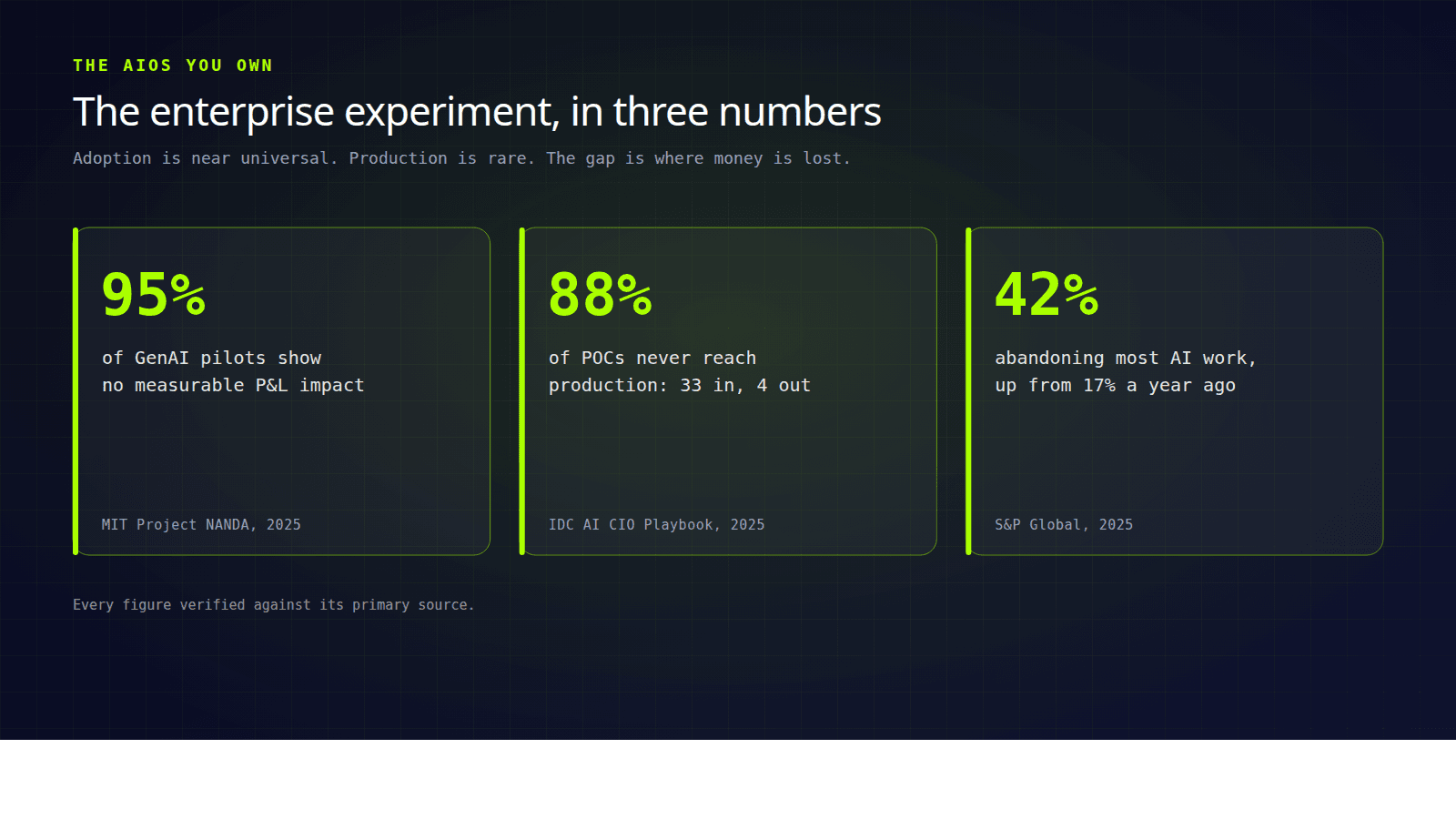
This is not one alarming number from one report. It is a pattern that independent research keeps reproducing from different angles. IDC, in its AI CIO Playbook 2025, found that for every 33 AI proofs of concept an enterprise starts, only four reach production, an 88% attrition rate before a system ever goes live. S&P Global Market Intelligence tracked the share of enterprises abandoning most of their AI initiatives rising from 17% to 42% in a single year. McKinsey’s 2025 State of AI survey found roughly 62% of organisations experimenting with AI agents but only around 23% running them in production. Adoption is near universal. McKinsey puts the share of organisations using AI in at least one function at 88%, up from 78% the year before. Production is rare. The gap between those two numbers is where the money is being lost.
What is striking, across all of this research, is the agreement on the cause. The failures do not cluster around model quality. The models work. They cluster around data readiness, integration with real systems, and the absence of a defined business outcome before the build begins. The pilot ran on clean, curated data in a sandbox. Production presented messy data in legacy systems that nobody owned end to end, and the system stalled. The technology was never the bottleneck. The operating model was.
The failure is an ownership failure, not a technology one
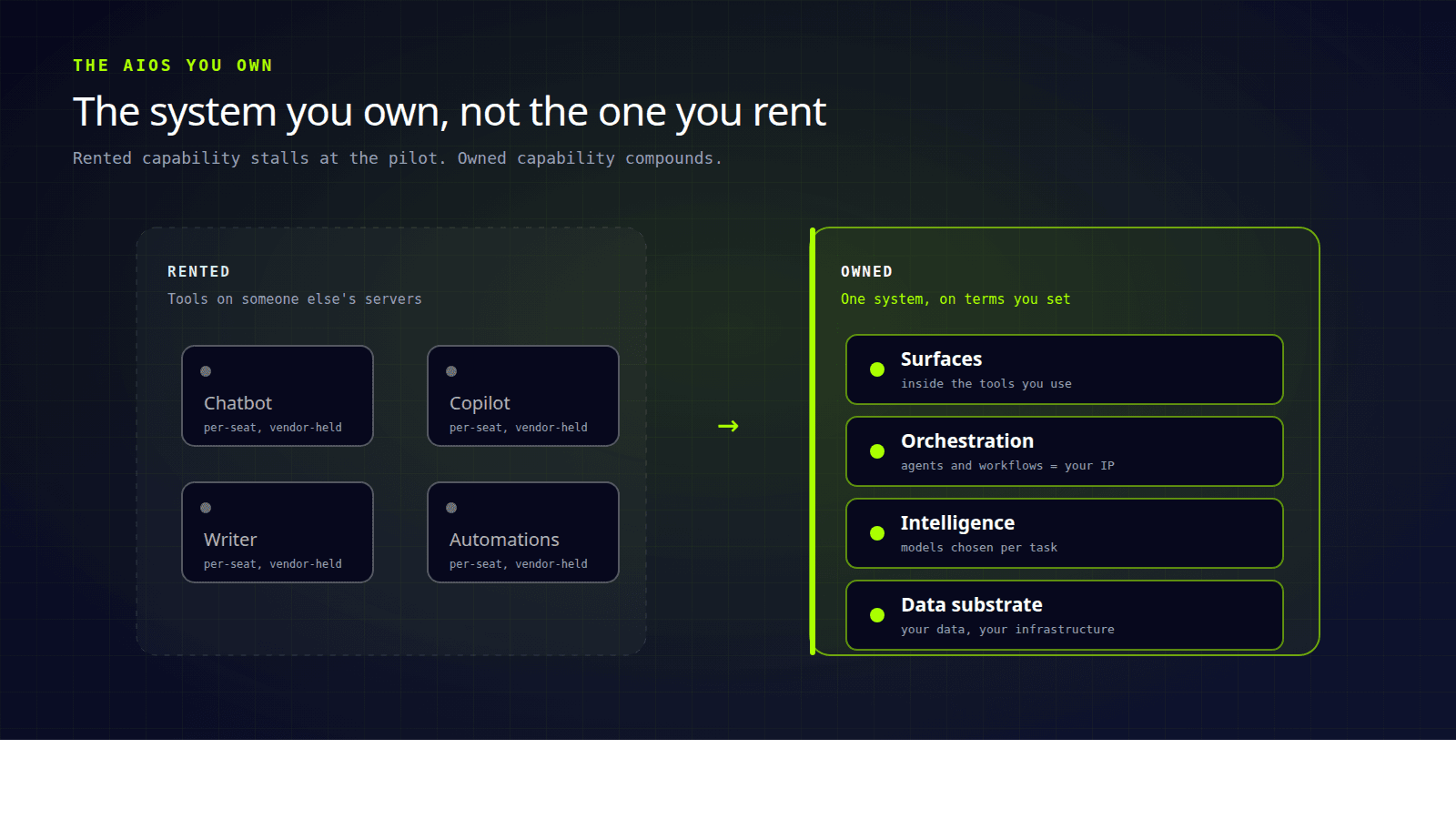
Look closely at those root causes and they describe one thing: a firm that does not own its AI capability, only rents pieces of it.
When you buy AI as a subscription, three things follow, and the failure data is downstream of all three.
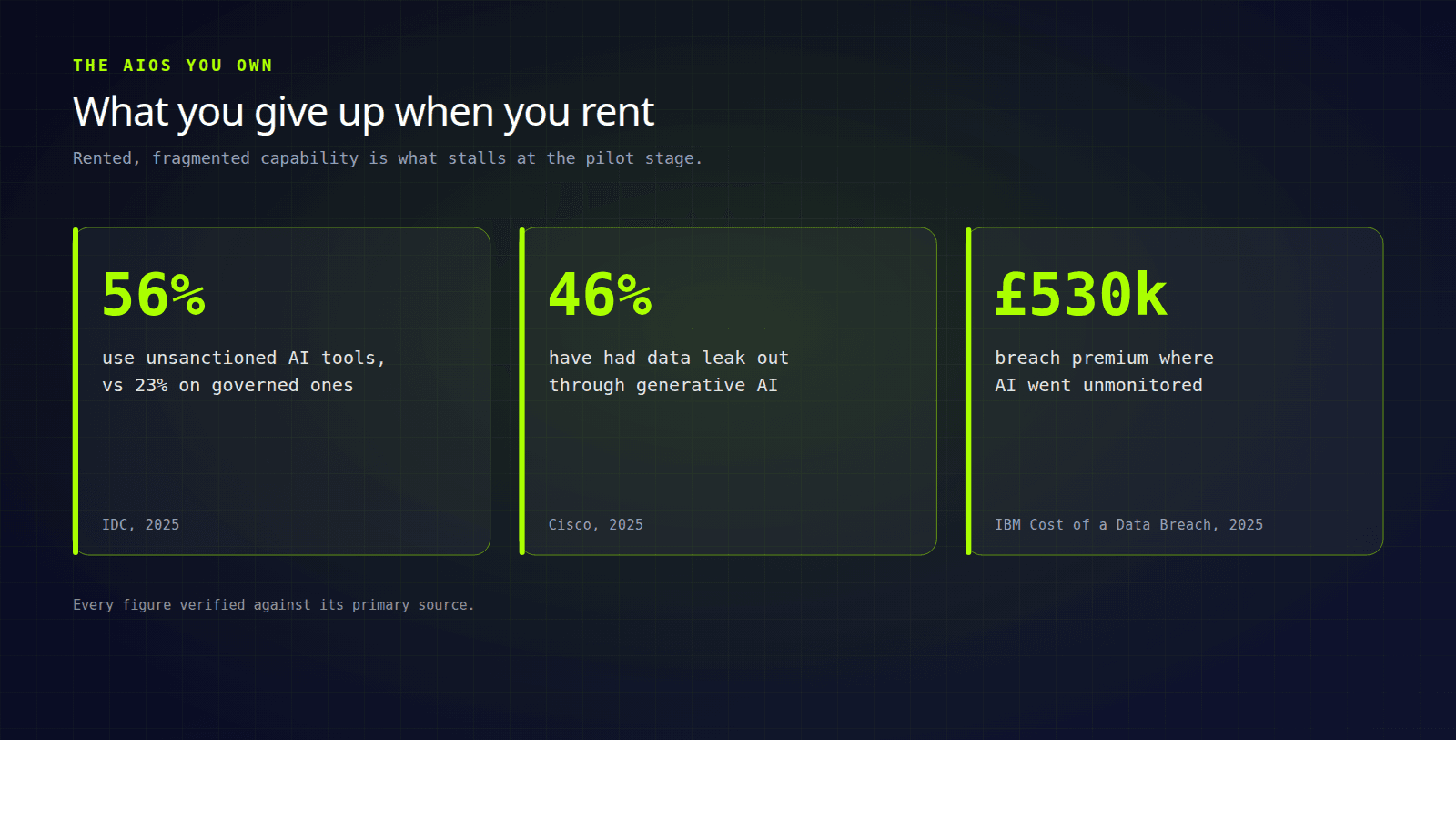
Your data leaves your control. To work, the tool ingests your records and documents, which now sit on a vendor’s infrastructure under terms you did not write. This is not a fringe concern. IDC’s 2025 research found that 56% of employees use unauthorised AI tools at work while only 23% use AI their organisation actually provides and governs. Cisco’s 2025 study found that 46% of organisations had already experienced internal data leaks through generative AI. IBM’s 2025 Cost of a Data Breach report put the premium for breaches involving unmonitored AI at roughly £530,000 (around $670,000) above a standard incident. A capability built on data you have effectively posted to other people’s servers is not a capability you control. It is an exposure you have not priced.
Your work product is not yours. The prompts, workflows and automations your team builds inside a rented tool are features of that tool. They do not leave with you when the contract ends. Every month spent shaping a generic product around your business is value accruing to the vendor’s retention numbers, not your balance sheet.
Your costs are someone else’s lever. Per-seat pricing and usage billing move in one direction, and they move fastest precisely when the tool has become load-bearing. The more your operations depend on it, the more pricing power the vendor holds. That is not a defect in the model. It is the model.
None of this makes AI tools worthless. It makes them rented, and the research is now clear that rented, fragmented capability is what stalls at the pilot stage. You cannot integrate deeply into systems you do not own, govern data you have handed away, or define outcomes for a tool that was built for someone else’s.
But does not the same research say building fails too?
Yes, and this is the part most vendors and most consultants skate over, so it is worth meeting head on.
The MIT NANDA report contains a second finding that looks, at first, like a problem for everything above. Purchasing AI from specialist vendors and building partnerships succeeded about 67% of the time, while internal builds succeeded only about a third as often. Read carelessly, that says: do not build, just buy. If that were the lesson, the rent-it-all approach would be vindicated.
It is not the lesson, because it conflates two different things the data actually separates. The 95% failure rate is not a story about firms that built. It is overwhelmingly a story about firms that bought generic tools and expected them to adapt to workflows they were never designed for. The same MIT research notes that general-purpose tools stall in enterprise use precisely because they do not learn the workflow. Meanwhile, the approach with the best odds in the data is not "buy off the shelf" and it is not "build it yourself in a vacuum." It is partnership: a specialist building a system fitted to your data and your processes.
That is the quadrant almost nobody occupies and the one that wins. Not generic capability rented from a vendor. Not an unaided internal build by a team learning as it goes. A system designed and built for you, by people who do this specifically, that you then own. The failure data does not argue against owning your AI capability. It argues against owning it badly and alone, which is a different thing, and a solvable one.
Why the mid-market can do what the enterprise cannot
Here is the part the enterprise case studies will not tell you, because it is not about them.
The 95% failure rate is, to a large degree, a failure of scale and bureaucracy. A large enterprise runs AI pilots across dozens of business units, on data scattered through decades of legacy systems, governed by committees that cannot agree on ownership. The surface area is enormous, the data is a swamp, and the politics guarantee that most pilots die in what analysts have started calling pilot purgatory: neither shipped nor cancelled, just quietly defunded at the next budget review.
A mid-market firm has almost none of that. The data surface is bounded enough to actually get into one place. There is no twenty-person AI committee to satisfy, no decade of acquired systems nobody fully understands. A focused, well-built system can be designed, owned and run without an enterprise budget or an enterprise timeline, for the straightforward reason that a mid-market firm is not an enterprise and does not need to be treated like one.
So the enterprise failure data is not a warning to the mid-market. It is an opportunity. The thing that traps a 10,000-person organisation in pilot purgatory is the same thing a 100-person firm does not have. The mid-market is the band where owning your AI capability is both most valuable, because the cost of rented sprawl genuinely bites at this size, and most achievable, because the system is small enough to actually own. That is the work we do at Generativ, and it is deliverable precisely because we are not trying to boil a multinational’s ocean.
What you own when you own the system
An owned AI operating system inverts every failure mode above. Four things become yours.
Your data stays yours. It lives in your infrastructure, on your terms, and where it is sensitive, the models that work on it run in your environment rather than on a third party’s servers. This is where private and local AI earns its place: not as a compliance slogan, but as the difference between processing your own information and uploading it to someone else’s API.
Your IP accrues to you. The workflows, agents and institutional knowledge you encode become assets on your side of the line. They compound. Every process you systematise is value you keep, not a feature you forfeit at cancellation.
Your costs are predictable. You are buying a system, not a meter, and you are not exposed to per-seat inflation that scales with your own success or a repriced contract after the vendor’s next funding round.
Your system survives the vendor. Tools get sunset, pivoted and acquired constantly. When the AI provider you built around changes course, an owned system does not evaporate. You swap a component. You do not rebuild your operations.
What an owned AIOS actually looks like
Strip away the diagrams and an AI operating system is four layers, each answering the ownership question.
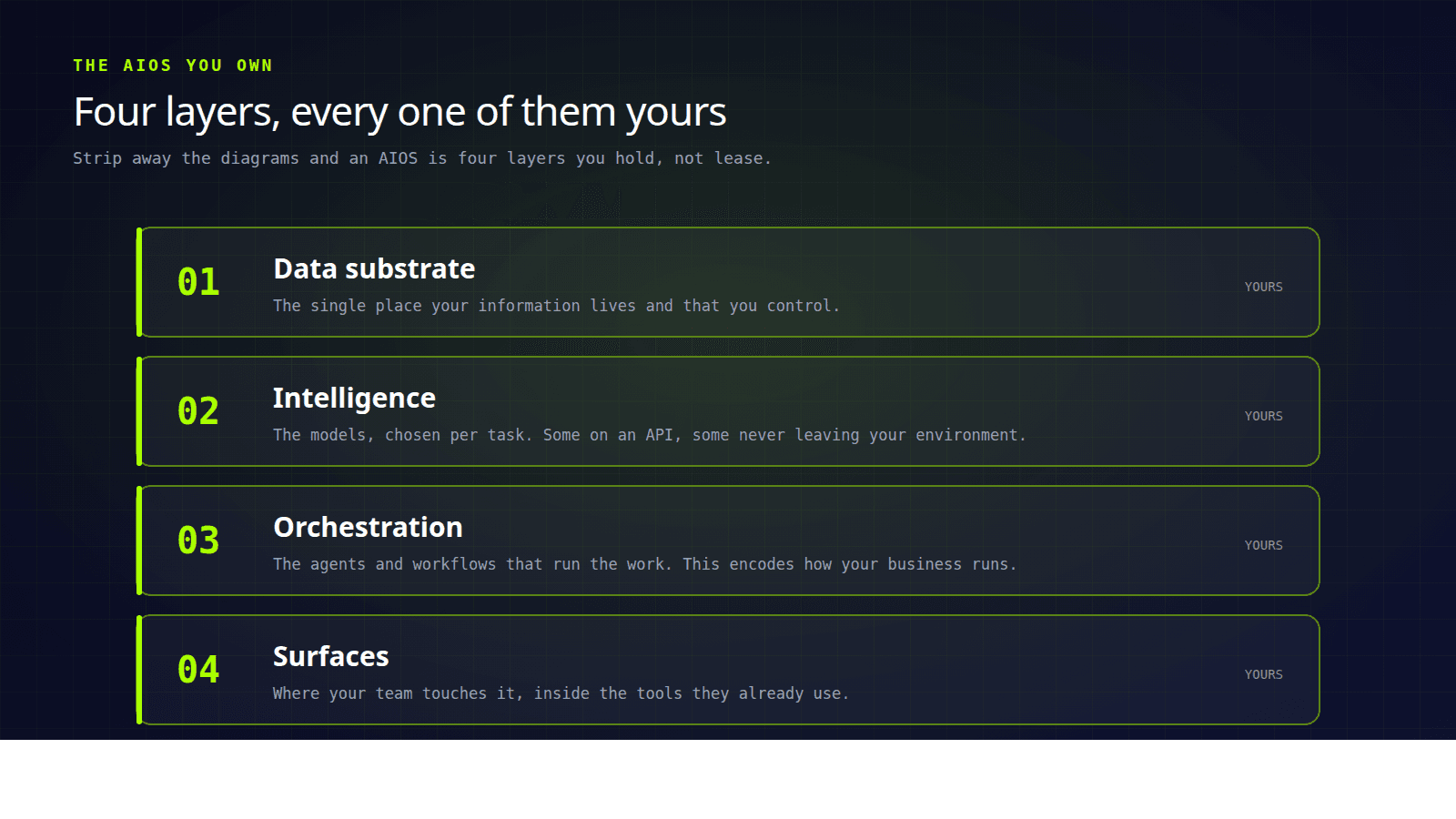
The data substrate is the single place your information lives and that you control, rather than scattered across vendor databases. It is the layer whose absence, the research is unanimous, kills most pilots.
The intelligence layer is the models themselves, chosen per task rather than per subscription. Some work runs fine on a commercial API. Some should never leave your environment. An owned system lets you make that call deliberately instead of having it made for you by whichever tool you happened to buy.
The orchestration layer is where the work happens: the agents and workflows that qualify a lead, draft the follow-up, update the record, flag the exception. This layer encodes how your business runs, which is exactly why it should be your IP and not a vendor’s feature set.
The surfaces are where your team touches it, inside the tools they already use, so the system disappears into the work rather than becoming another tab nobody opens.
We go deeper on the architecture in What Is an AIOS?, and the build itself is what our AIOS design and integration work delivers. The shape matters less than the principle: every layer is something you hold, not something you lease.
Where this leaves you
If AI is a side experiment in your firm, keep renting. Genuinely. Buy the tools, run cheap trials, learn. The failure rates only matter when you are depending on the outcome.
If AI is becoming part of how your business actually operates, the enterprise data is your warning and your edge at once. The firms losing the most money are the ones renting fragmented capability at scale. You are positioned to do the thing they cannot: own an integrated system, built around your data and your processes, on terms you set.
The Local AI OS Generativ worked with us to build has helped us reduce time spent on project management, particularly from a creative iterations perspective, by 40%, freeing up more capacity for us to introduce new projects.
Arni Locher, MeetInfinite
That is what Generativ designs and builds for mid-market firms. We start by mapping where your AI capability currently lives, who owns it, and what it would take to bring it home. If that is the decision in front of you, book a consultation and we will tell you honestly whether building or buying is the right call for your situation. The research says that for most generic use cases, off-the-shelf is fine. For the systems your business will come to depend on, it is not. Knowing which is which is most of the value.
Sources
- MIT Project NANDA, The GenAI Divide: State of AI in Business 2025 (95% of pilots with no measurable P&L impact; build-versus-buy success rates).
- IDC, AI CIO Playbook 2025 (88% of POCs never reach production; 33 POCs to 4 in production). Reported via CIO, March 2025.
- IDC, 2025 shadow AI usage survey (56% unauthorised tool use versus 23% governed).
- S&P Global Market Intelligence, 2025 (AI abandonment rising from 17% to 42% year on year).
- McKinsey & Company, State of AI 2025 (88% using AI in at least one function; 62% experimenting with agents, 23% scaling).
- Cisco, 2025 study (46% of organisations reporting internal data leaks via generative AI).
- IBM, Cost of a Data Breach Report 2025 (circa $670,000 premium on AI-related breaches).
Part of the Generativ AIOS cluster. Related: What Is an AIOS?, AIOS design, AIOS integration, our solutions.