AI Theatre vs AI Integration: How Real AI Integration Works
Most businesses are still performing AI adoption. The real advantage comes from integrating AI into the way work actually moves.
There is a quiet divide opening up in business right now.
You will not see it in the marketing. The LinkedIn posts look identical. Everybody is announcing their "AI workflow" or "killer Claude prompt" with the same stock imagery and the same buzzwords.
Underneath the announcements, something very different is happening.
One group of companies is using AI for appearance. They label tools "AI-powered" in the email signature, generate content with ChatGPT and post about how innovative they are. Inside the business, lead response time is still four hours, sales still rekey duplicate notes, and support still answers the same fifty questions every day.
The other group is doing something unglamorous and effective: real AI integration. They are rebuilding how work actually moves. Not bolting AI on top of broken processes, but redesigning the processes around what AI now makes possible. That is the shift from performative AI adoption to an AI operating system.
Those are not remotely the same thing. And the gap between them is widening fast.
The hype cycle is over. Real AI integration is where it gets serious.
For about two years, the dominant question around artificial intelligence was: "What can this thing do?" That was the curiosity phase, and it made sense. Through natural language processing, modern AI models could summarise documents, write emails, generate images, build code and answer almost any question. Everything felt limitless.
Now the question has changed.
"Where does this actually belong inside the business?"
That is an operational question. And operational questions are where hype either survives reality or dies quickly. The moment AI moves from demo to implementation, businesses run into something uncomfortable: most companies are not optimised operationally enough to absorb AI capabilities.
AI exposes inefficiency long before it solves it. That is the part nobody wanted to talk about during the hype cycle, and it is the issue most companies need to tackle before AI initiatives can move the commercial numbers.
What real AI integration actually looks like
Definition. AI integration is the redesign of business workflows so AI implementation becomes operational infrastructure. The aim is not to embed AI at every step for show, it is to let AI do the heavy lifting where it genuinely accelerates the work, and to leave it out where it does not.
The difference shows up in the details.
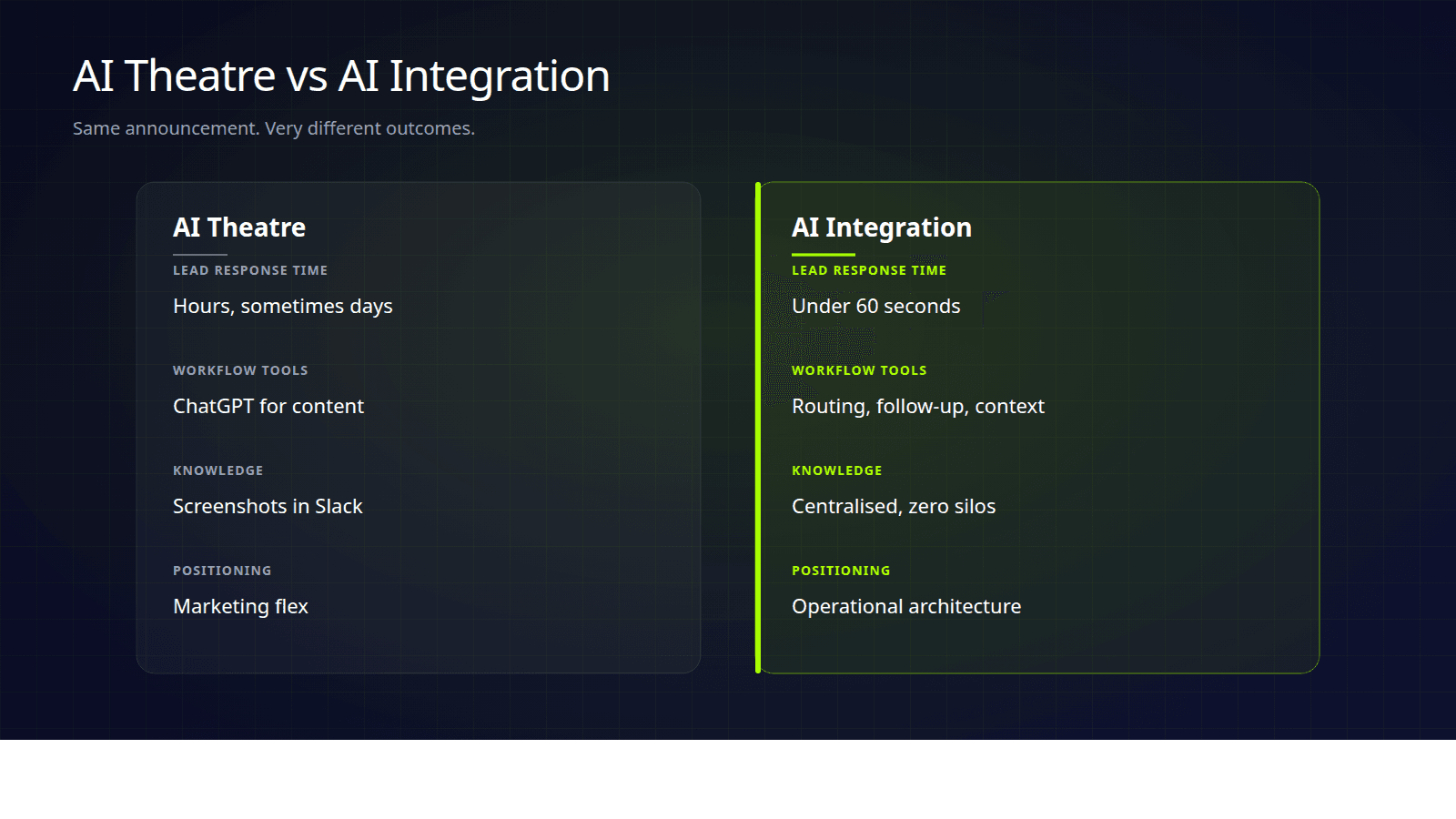
Response time
Theatre: four hours or more. Integration: under sixty seconds.
Workflow tools
Theatre: ChatGPT for the occasional bit of content. Integration: automated routing, personalisation and follow-up across the customer journey.
Internal culture
Theatre: forwarding AI screenshots around the team. Integration: centralised knowledge with no silos.
Positioning
Theatre: a marketing flex. Integration: operational architecture.
AI integration amplifies structure. If the structure is good, AI creates leverage. If the structure is chaotic, AI accelerates the chaos. This is why so many AI pilots fail. The models are not weak. The problem is that businesses try to layer AI on top of broken systems, and AI gets blamed for what was already broken.
Decision compression and AI data integration
One of the most underrated outcomes of proper AI integration is decision compression, driven by a shared knowledge base where AI agents can read from the data the business already holds.
Modern customers expect immediate responsiveness. Not eventually, immediately. If somebody submits a lead form and hears nothing for three hours, the psychological trust starts degrading, not because three hours is objectively long, but because digital expectations have been reset.
The traditional workflow looks like this: lead lands in the CRM, somebody sees it later, a task gets assigned, an email goes out, maybe a call eventually happens. By the time any of that is true, the emotional energy that triggered the enquiry has already cooled off. In a low attention span world, a lead is motivated in the moment. That moment matters.
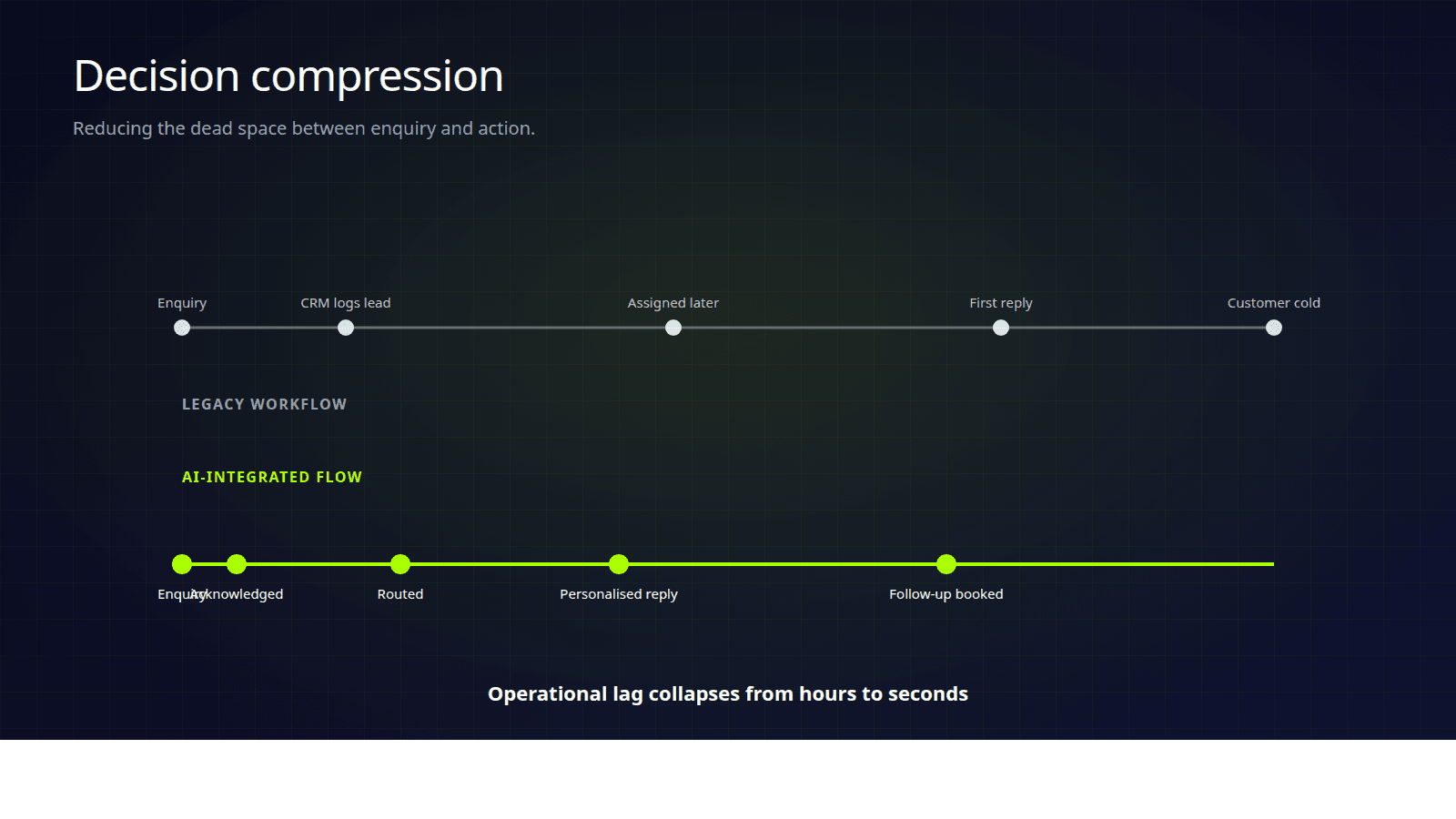
Proper AI integration changes the dynamic completely.
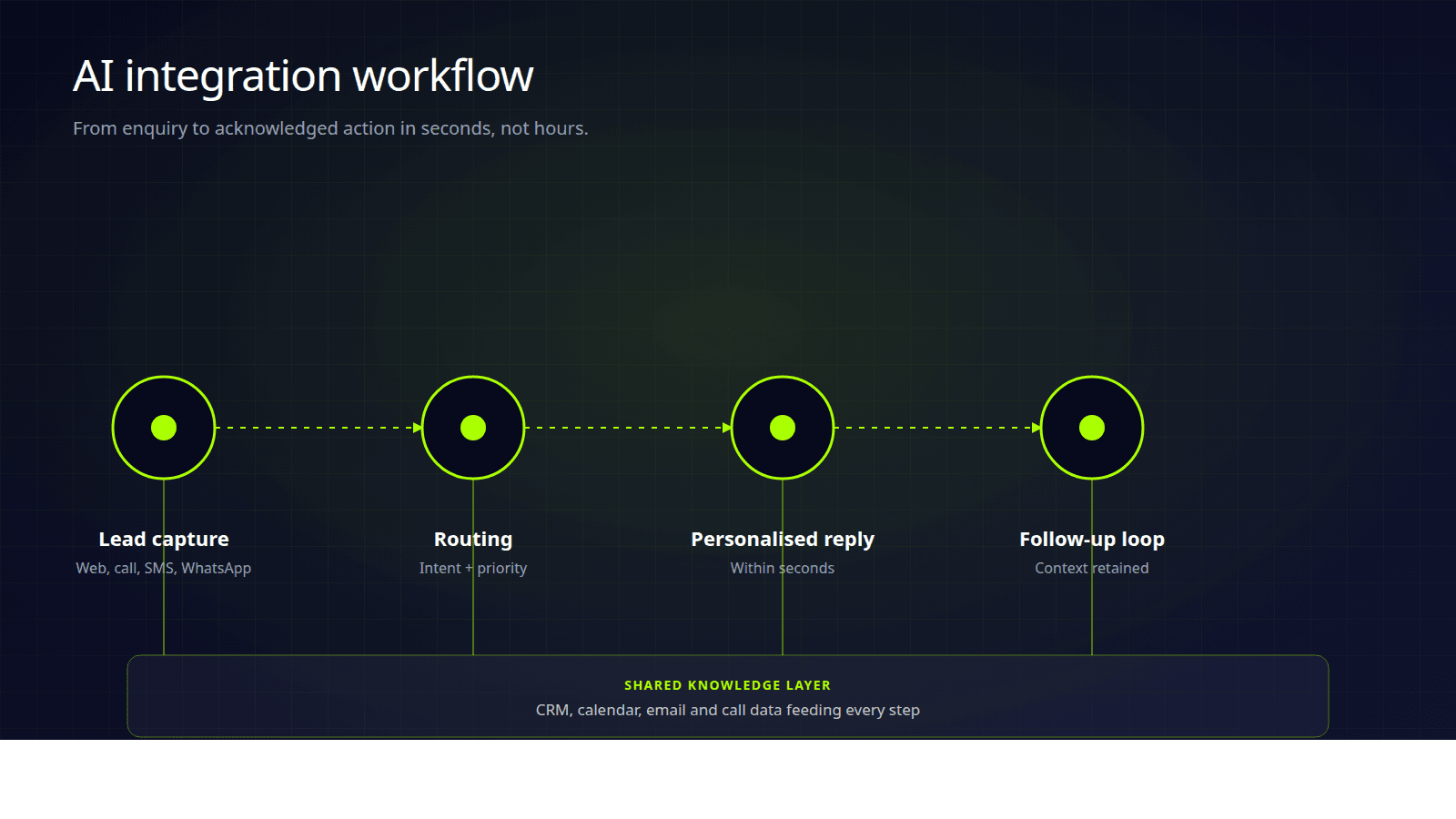
- Instant response. The enquiry is acknowledged within seconds, not hours.
- Intelligent routing. The right person, the right context, surfaced immediately.
- Personalised follow-up. Context carried across the conversation, not lost between systems.
- Zero operational lag. The gap between enquiry and action shrinks to near zero.
This is where modern AI moves from hypothetical to operational. Lead after lead, customer after customer. The compounding effect of removing dead space from every interaction is enormous, and it is the fastest way for an SMB to book more appointments from the same volume of leads.
AI integration exposes the system problems you have been ignoring
Real AI integration forces businesses to confront structural issues they have tolerated for years.
- Slow communication and broken handoffs.
- Information silos between departments.
- Poor documentation and patchy training.
- No centralised knowledge base.
- No operational consistency.
- No visibility into the customer journey end to end.
These problems existed long before AI. People were simply compensating for them manually, working longer hours, sending more emails and holding more meetings. AI integration makes the difference between a real system and good staff working around legacy systems impossible to ignore. AI cannot compensate for chaos. It reveals it. Every broken handoff, every missed follow-up, every duplicated process becomes visible the moment you try to build intelligence into it.
Some companies will realise they never had operational systems in the first place. That is uncomfortable. It is also the starting point for real advantage.
The trust problem AI integration must solve
There is a paradox emerging: as AI-generated communication becomes infinitely scalable, sincerity becomes more noticeable.
Nobody wants to feel processed, especially in high-trust industries: mortgage, real estate, legal, financial services, healthcare. Automation without emotional intelligence creates resistance fast, which is exactly why responsible AI practice should sit near the top of any enterprise AI integration plan.
Unlike some of the recent commentary from large platform CEOs, we treat human adaptability as a real commercial asset. The genuine benefit of AI integration is rarely a step-change in headcount cost. It is the increase in human capacity to move away from low-value, repeatable tasks and focus on pulling strategic levers.
The businesses winning with AI integration understand something critical. It is not about replacing humans. It is about replacing operational dead space so humans can do what they are best at: building relationships, exercising judgment and handling complexity.
Operational trust plus AI efficiency.
Fast systems. Clear communication. Human awareness. Low friction. High responsiveness. Context retention. Consistency. Companies that combine all of these elements feel fundamentally different to work with. Customers do not say, "Wow, this company offers an incredible AI service." They say, "These people are unbelievably responsive. Everything felt easy."
That is the difference between AI theatre and AI enablement.
How to start a real AI integration process (not theatre)
For UK SMBs ready to move beyond the announcement stage and start building something that actually works, here is the honest path.
1. Audit your operational friction
Map the customer journey from first touch to conversion. Where are the delays? Where do handoffs break? Where does information get lost? Start there, not with the new AI tools.
2. Fix the structure before AI integration work
AI amplifies what already exists. If your CRM is messy, AI will produce messy outputs faster. Clean the foundation first.
3. Start with decision compression
The highest-ROI AI integration for most SMBs is speed to lead, supported by AI lead generation systems and AI lead qualification. Instant response, intelligent routing, personalised follow-up. It is measurable, it compounds, and customers feel it immediately.
4. Build invisible AI
Do not announce every AI feature. Just make the experience smoother. The best AI integration is undetectable. It just feels like good service.
5. Know where to integrate AI and where automation should stop
Map which interactions benefit from AI and which require human warmth. Design the handoff. The balance is where trust lives.
How Generativ approaches integrating AI systems
Most AI consultancies sell strategy. We sell working systems.
That distinction sits at the heart of how Generativ approaches AI integration across our clients, and it is the clearest line between what we do and what the rest of the market offers. Walk through the websites of the larger UK AI consultancy firms and a familiar pattern appears: opportunity maps, three-year transformation roadmaps, governance frameworks and executive strategy documents. These have their place, usually inside FTSE 250 boardrooms with seven-figure budgets and a two-year horizon to ROI. They are not built for the SMB owner who needs more booked appointments next month.
Generativ was built for that second group, and the approach reflects it.
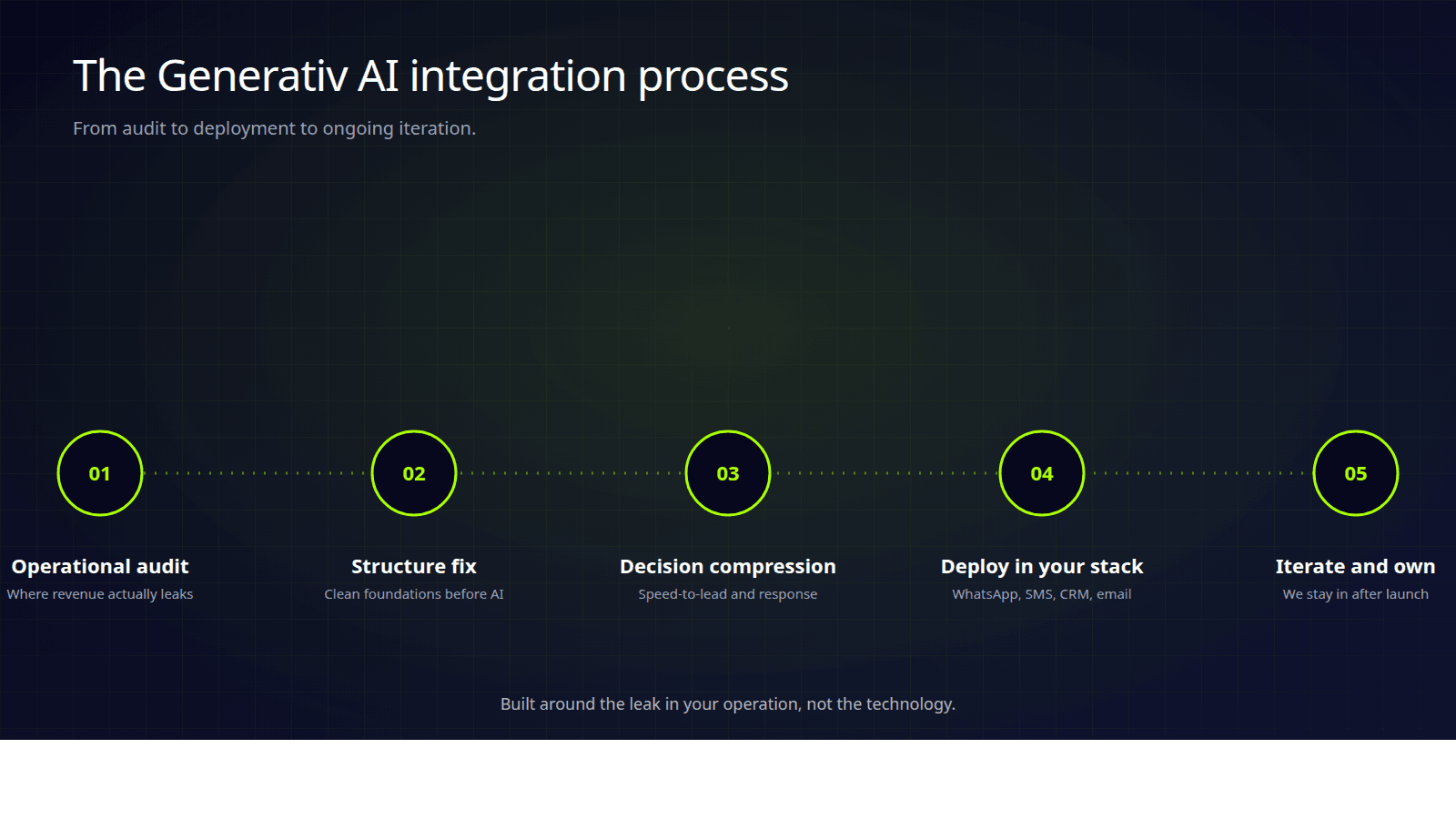
We start with the inefficiency or capability gap, not the technology
The typical AI consultancy engagement starts with a discovery phase designed to identify where AI could be applied across an organisation. That sounds reasonable until you notice it produces a deliverable rather than a result. Gartner now predicts that roughly 30 percent of generative AI projects will be abandoned after proof of concept. That happens because too many engagements end at the slide deck.
Our discovery is narrower and more honest. We look for the specific places where revenue is leaving the business: enquiries that go unanswered after 5pm, follow-ups that never happen because the team is on a job, quotes that sit in drafts and invoices that get chased manually. These are not AI problems in the abstract. They are operational gaps where AI happens to be the right tool. We build around the leak, not around the technology.
We design integrations for the tools your team already uses
A surprising amount of "AI transformation" work assumes the client will adopt new software, new dashboards, new logins and new workflows. For an enterprise with a change management budget that is fine. For most SMBs that is a significant outlay.
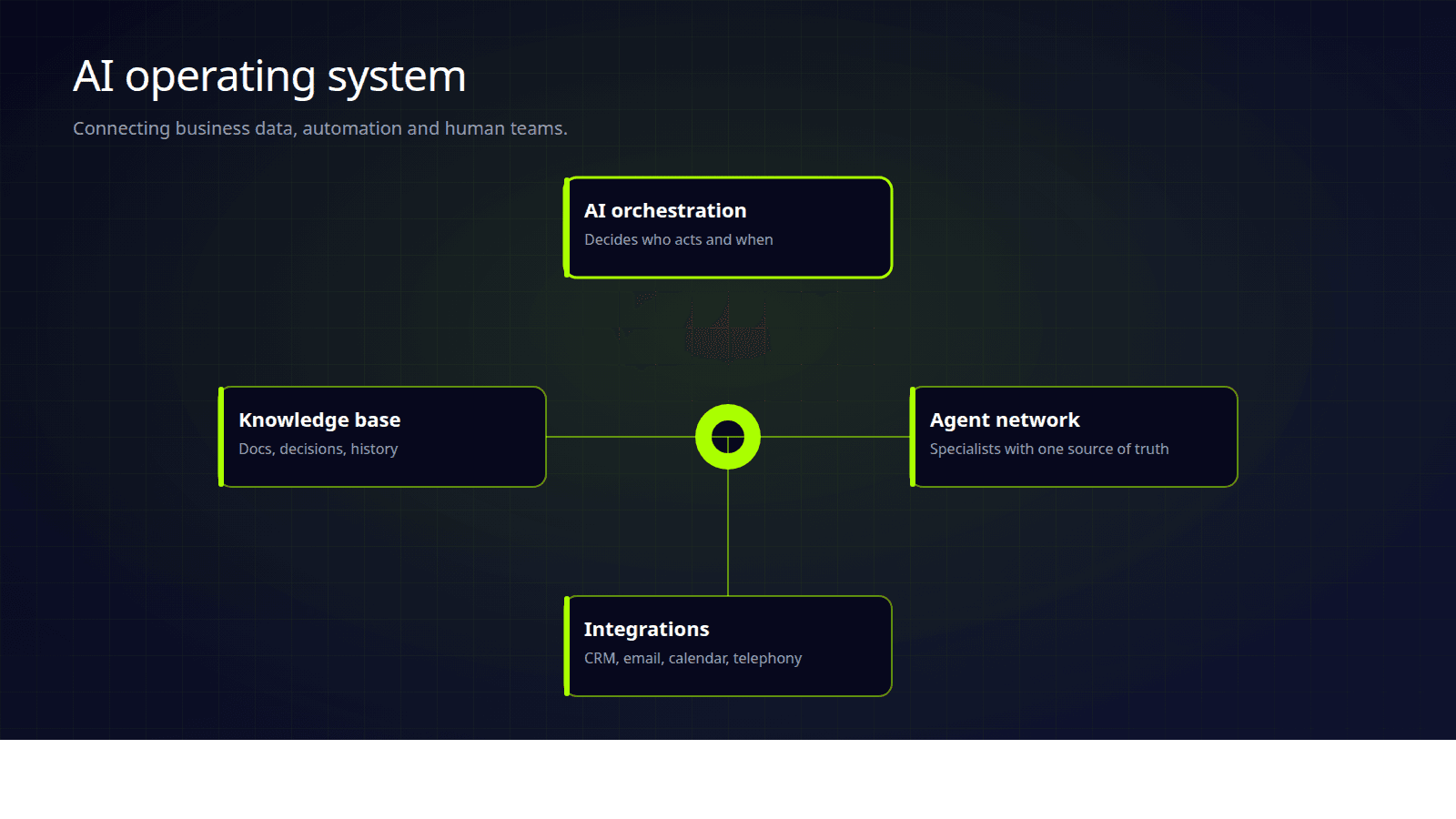
We design automation that lives inside the channels SMBs already operate in: WhatsApp, SMS, phone, email and the calendar already woven into the team. Our approach to AI marketing automation and operational AI is platform agnostic. The system works in the background. The user-facing surface stays familiar. This is a deliberately unglamorous design philosophy, and it is one of the strongest predictors of whether a system actually gets used six months after launch. We design an AIOS around your existing business infrastructure.
We combine industry experience with implementation capability
Most AI consultancies are technology firms that have learned to talk about marketing, operations, HR or finance. Most AI-first marketing agencies are firms that have learned to talk about AI but lack operational experience beyond their direct niche. Both gaps create the same outcome: clients receive either a sophisticated system that does not move commercial metrics, or a marketing campaign that uses ChatGPT as a writing assistant and calls it AI integration.
Generativ sits in the overlap. The team brings over a decade of experience across performance marketing, finance, legal and HR, alongside hands-on AI work since 2015. That means an AI deployment for a Generativ client is judged against the metrics that actually matter for each department, whether that is CPA, CAC, LTV, conversion rate, response time, employee retention or time to payment, not against technical benchmarks that do not pay anybody’s salary.
We stay involved after launch
The traditional consultancy model is structured around handover. Strategy is delivered, implementation is somebody else’s problem and the relationship ends. That works for large organisations with internal capability to run what they have been given. It fails almost everywhere else.
Our engagements are designed around the assumption that the client does not have an internal AI team and should not need one. We build, we deploy, we monitor, we iterate. When Google releases a new ad format, when an LLM provider changes its pricing, when an automation breaks because a third-party API changed, we handle it. The relationship is closer to a fractional AI team than a traditional consulting engagement.
The result: effective AI in your business
Clients work with us because they want the outcome, not the artefact. No 80-page strategy document. No governance committee. No eighteen-month roadmap. A working system that captures more of the leads they already pay for, runs while they sleep and pays for itself inside the first quarter.
That is the difference.
In summary
- AI theatre is the announcement of AI without changes to how work actually moves.
- AI integration is the redesign of workflows so AI implementation becomes operational infrastructure.
- Most AI pilots fail because businesses bolt AI on top of broken systems instead of fixing the structure first.
- The fastest ROI for SMBs is decision compression: instant response, intelligent routing and personalised follow-up.
- Real AI integration is invisible. It feels like an unusually responsive, well-run business.
Move from AI theatre to real AI integration
If you are ready to move from AI theatre to real AI integration, explore our AI integration services and AIOS design. We build operational intelligence systems for UK businesses. Not demos. Not announcements. Systems that make companies faster, smoother and more coherent.
Book a consultation with Generativ or get in touch and we will map the specific places where AI integration would move your commercial numbers.
Frequently asked questions
What is AI theatre?+
AI theatre is the performative side of AI adoption. Companies announce "AI-powered" tools, generate content with ChatGPT and rebrand themselves as innovative, but the underlying workflows do not change. Lead response is still slow, knowledge still lives in silos, and the operational experience for customers and staff is the same as it was before.
What is AI integration?+
AI integration is the redesign of workflows so that AI becomes operational infrastructure rather than a novelty. It connects the data the business already holds with the channels customers and staff already use, so that responses are faster, routing is smarter, follow-up is consistent and human teams spend their time on judgment work.
Why do AI pilots fail?+
Most AI pilots fail because businesses try to layer AI on top of broken processes. AI amplifies whatever structure already exists. If the structure is messy, AI creates messy outputs faster. The pilots that succeed are the ones where leaders treat AI integration as an operational redesign, not a software purchase.
What is the difference between AI automation and AI integration?+
AI automation typically refers to discrete tasks: an auto-reply, a generated draft, a single workflow. AI integration is broader. It is the connective architecture across data, channels and teams that makes those tasks part of one coherent system. Automation is a feature. Integration is the system the features live inside.
How should a small business start with AI integration?+
Start with operational friction, not technology. Map where revenue actually leaks: unanswered enquiries, slow follow-up, missed quotes, duplicated work. Fix the structural gaps first, then introduce AI at the point of highest leverage. For most SMBs that point is speed to lead, where instant response and personalised follow-up compound across every customer interaction.
How does Generativ approach AI integration?+
We start with the leak, not the technology. We design AI systems that live inside the channels your team already uses, build around your existing CRM, calendar, email and telephony, and stay involved after launch to iterate as models, ad platforms and integrations change. The goal is a working system that pays for itself inside the first quarter, not a strategy deck.