Generative Engine Optimisation: What GEO & AI Search Means in the Interpretation Economy
What GEO and AI search mean for modern marketing, why AI engines now shape buyer shortlists, and how brands can build a Truth Map to get cited.
For two decades, marketers obsessed over SEO. Rankings, search visibility, backlinks, keyword density, snippet optimisation, an entire industry grew up around the question of how to please one algorithm at one company in Mountain View. It worked, mostly, because the unit of value was the click. Get to page one, get the traffic, win the deal.
That game is being quietly dismantled. The replacement has a name you'll see everywhere this year: Generative Engine Optimisation, or GEO. It's the practice of optimising your brand, content and product information for the AI search systems, whether it's Claude, ChatGPT, Perplexity, Gemini and the agent layer being built on top of them, that now sit between buyers and the open web.
The art of getting LLMs to recommend you is not SEO with a fresh coat of paint. It's the response to a much deeper shift from traditional search, what I'd call the interpretation economy, and most marketing teams haven't yet noticed how much it changes the job.
From attention (SEO) to interpretation (GEO)
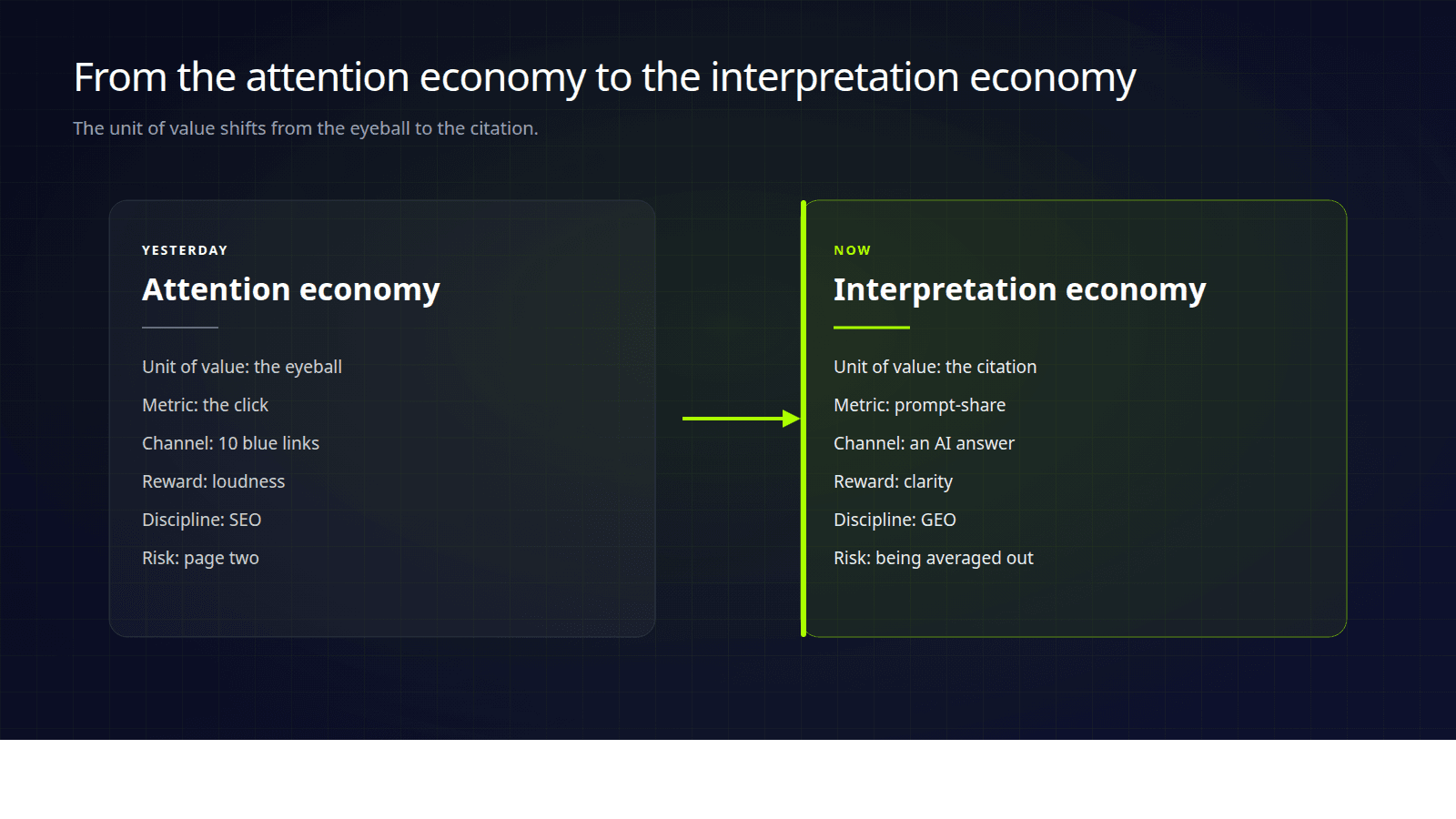
The attention economy rewarded loudness. Whoever could be the most distinctive, have the most emotional, brand mentions, be the most thumb-stopping, won. The unit of value was the eyeball; the metric was the click. Whole careers were built on making humans pause for half a second longer than they meant to.
The interpretation economy rewards something different. Your buyer is no longer scrolling Google's search results tenth page. They're asking an AI: "Who should I hire for this?", "What's the best CRM for a 12-person sales team in regulated finance?", "Is this company any good?" Whatever the generative search says back is, for most practical purposes, what your brand is now.
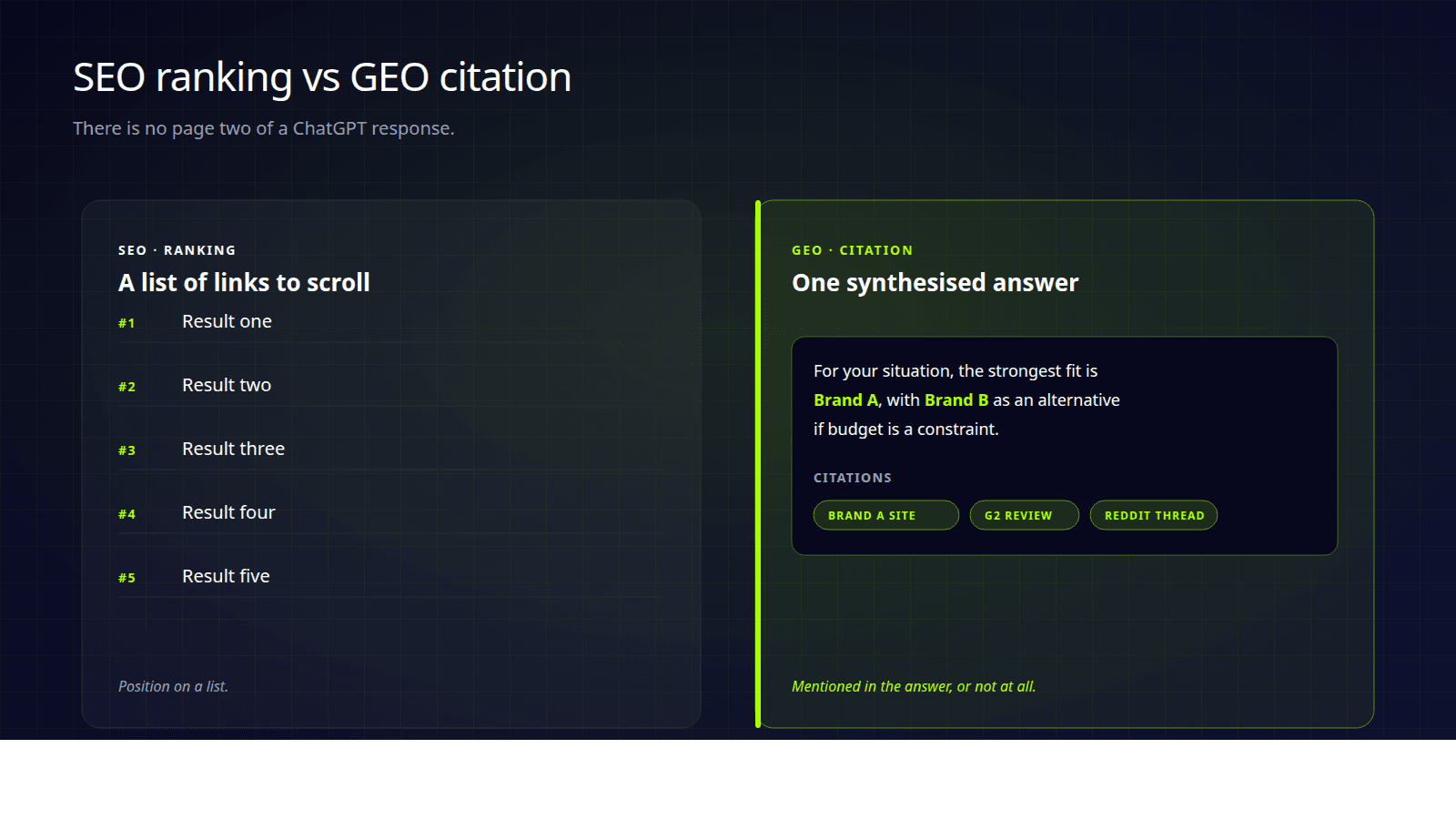
This is the world AI Optimisation exists to address. SEO optimised for google search indexing pages. GEO optimises for AI overviews synthesising answers. The crucial difference: SEO got you ranked. AI SEO determines whether you get cited at all.
That distinction sounds small. It isn't. Ranking is a position on a list of links a human can scroll through. Citation is whether the large language model mentions you when it produces the answer the buyer actually reads. There is no page two of a ChatGPT response.
Buyers are using AI Search to outsource the shortlist
A few years ago, the B2B buying journey looked like this: notice a problem, Google it, click around, build a shortlist, ask a colleague, request a demo. Marketers spent fortunes trying to influence each stage with content, retargeting and salespeople with headsets.
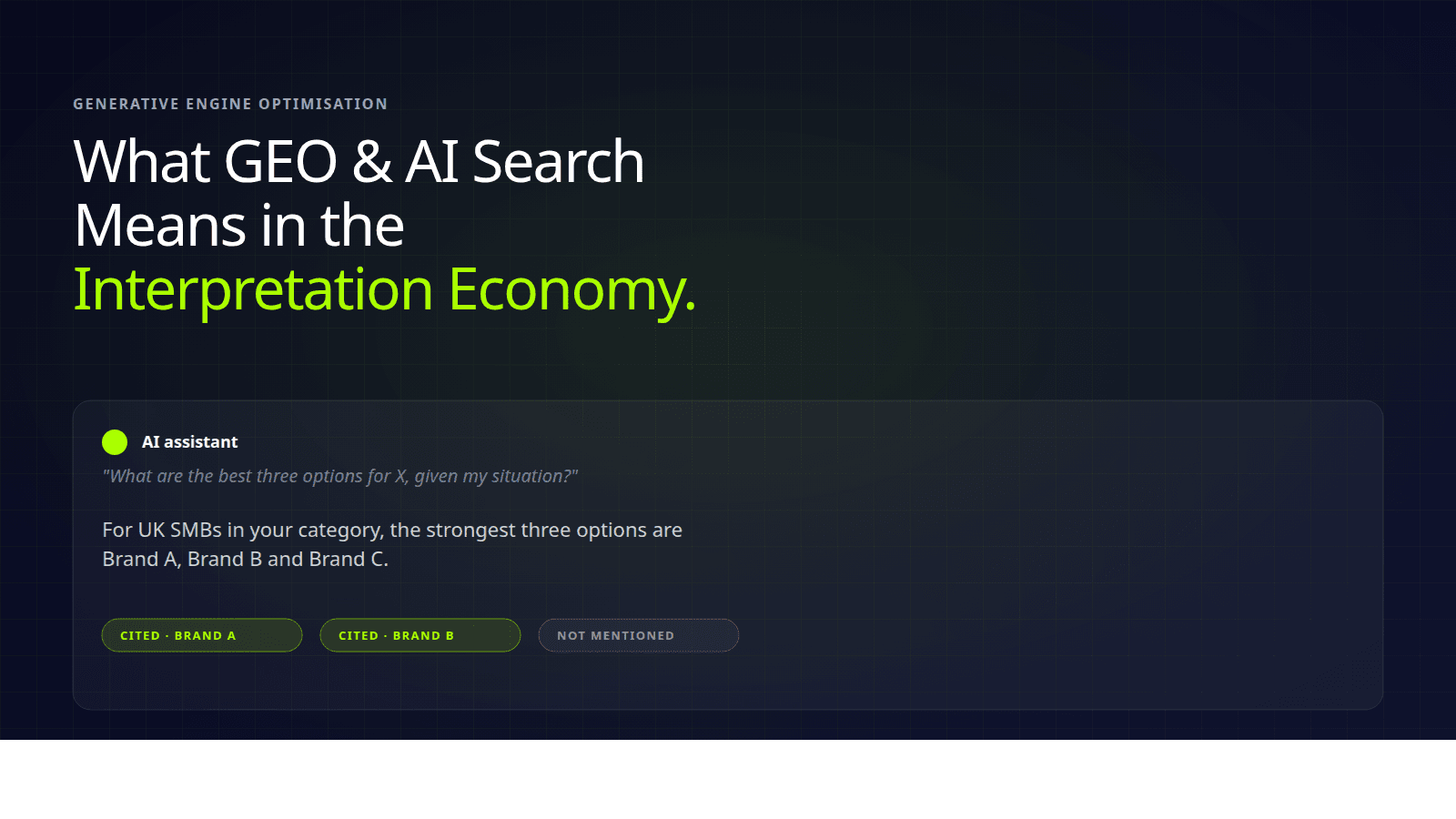
Now the journey is collapsing into a single prompt. "What are the best three tools for X, given my situation?" The model returns an answer. The buyer evaluates two or three options instead of ten. The shortlist is built before any human visits a single website.
If you're not in that shortlist, you don't lose the deal. You never enter the deal.
This is why optimising for AI engines matters and why it's not a side project. The criteria a answer engine uses to build that shortlist are not the ones SEO trained you to optimise for. It's not your colour palette. It's not whether your hero copy says "transform" or "reimagine". It's not even your domain authority. GEO is about whether there is structured, specific, verifiable information about your product, in enough places, written clearly enough, for the model to actually pick you up and use you in an answer in a conversational format.
Most companies are failing at this without realising it, because the failure mode is silent. You don't get a "you weren't recommended" notification. You just slowly notice the pipeline drying up.
What the best practices of Generative Engine Optimisation is actually building: a Truth Map
If SEO focuses on sitemaps, creating content and keyword relevance, GEO produces something I'd call a Truth Map: the layer of structured, provable, machine-readable information about your company, product or person that generative engines can navigate to understand you accurately.
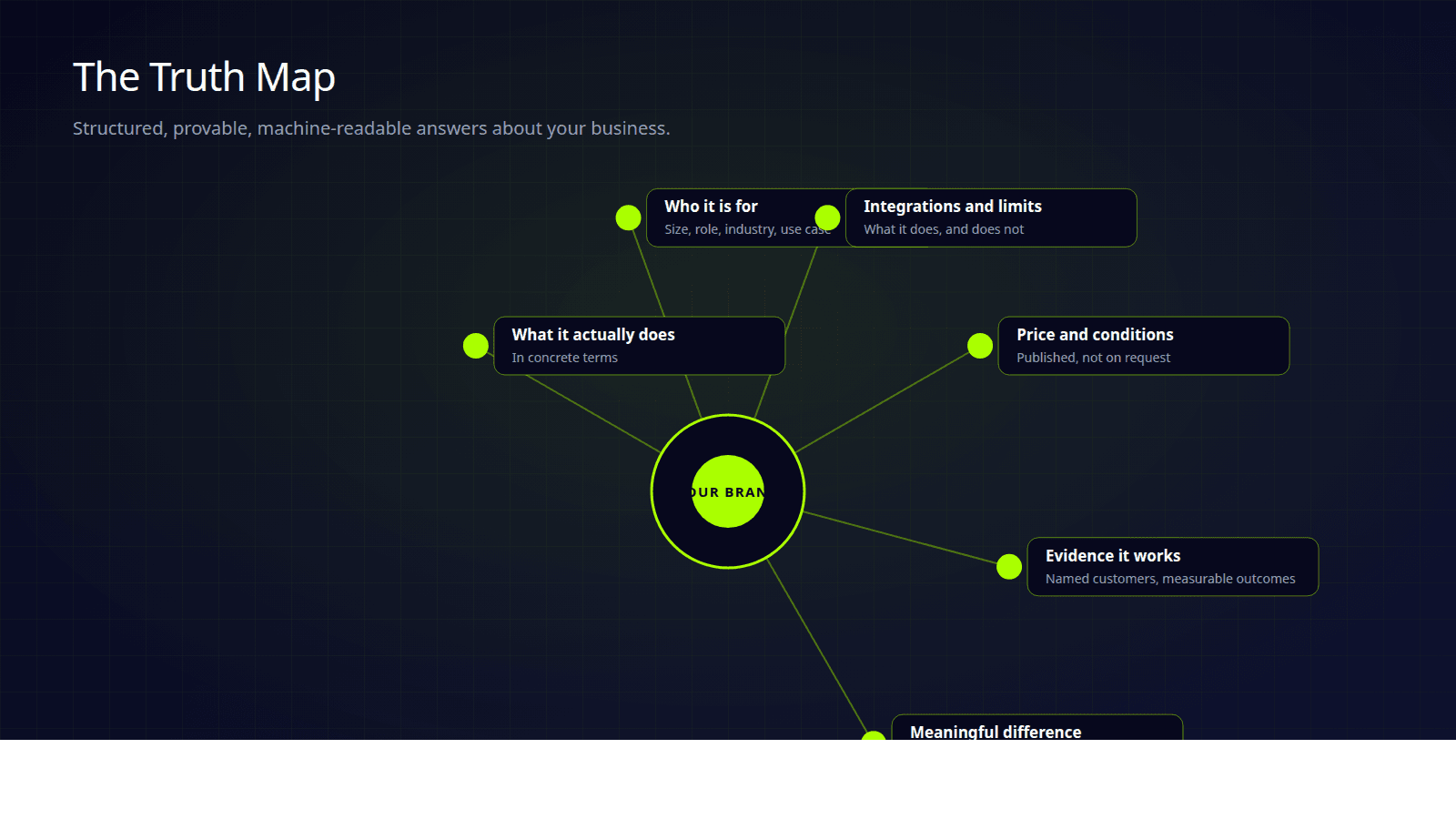
A Truth Map is the difference between vibes and coordinates. Your brand story is the vibes. Your Truth Map is the artefact used to produce the coordinates for AI-powered search.
A good Truth Map gives authoritative answers to things like:
- What does this product actually do, in concrete terms?
- Who is it for, specifically, what company size, what role, what industry, what use case?
- What does it integrate with? What are its limits? What does it explicitly not do?
- What does it cost, and under what conditions?
- What is the evidence that it works? Case studies, benchmarks, third-party reviews, named customers, measurable outcomes.
- What makes it meaningfully different from the three closest alternatives?
If your website can't answer these in language a model can parse, no amount of SEO trickery will save you. GEO is not, fundamentally, a technical optimisation problem. It's a clarity problem. You can have perfect schema markup and still be invisible if the underlying claims about your product are mush.
Most B2B websites today are the opposite of a Truth Map. They are mood boards with navigation. They tell me the company is "passionate about innovation" and "AI-driven" and "redefining the customer experience". They don't tell me what the thing does, who it's for, or why I should pick it over the competitor I just looked at five seconds ago. A human visitor might tolerate this. A generative engine reduces it to "B2B SaaS, possibly enterprise, unclear category" and recommends someone else.
Why emotional positioning breaks under AI Search Engines
There's a deeper shift happening here, and it's worth sitting with, especially if your current marketing is brand-led.
The playbook of the last decade leaned heavily on emotion, identity and narrative. "People don't buy what you do, they buy why you do it" became secular scripture. That advice was correct for humans scrolling Instagram. It is increasingly wrong for generative engines performing a comparison task on someone's behalf.
When a model summarises your value proposition, all the lyrical bits get compressed out. The metaphors evaporate. The aspirational language gets translated into something flatter and more functional. What survives the compression are the unfalsifiable specifics: the numbers, the integrations, the case studies, the named outcomes, the technical details.
If your differentiation lives in metaphors, it dies in the summary. This is the central technical reality that SEO and GEO has to grapple with, and the reason GEO can't just be a content rebrand of SEO. The optimisation surface has changed. You're no longer optimising for a ranking algorithm; you're optimising for a reasoning process.
This doesn't mean emotion is dead. It means emotion alone can no longer carry your positioning. You need a Truth Map underneath it that holds up under interrogation. You need evidence. Specific customers. Specific results. Specific use cases. Specific limits.
The brands that win the interpretation economy will be the ones brave enough to say things like: "We're the best choice if you have between 50 and 500 employees and you sell into regulated industries. If you're smaller, use Tool X. If you're larger, use Tool Y."
That sentence is heresy to most marketers. It involves turning customers away. It involves naming competitors. It involves opinions, and opinions are risky. But it's exactly the kind of statement a generative engine will quote when someone asks for a recommendation, because it's useful. It helps the model do its job. Vague positioning gets averaged out. Opinionated positioning gets cited. That's the entire GEO thesis in one sentence.
What Generative Engine Optimisation strategies actually involve
If you want a working definition: Generative Engine Optimisation is the practice of structuring content, claims and signals so that generative engines surface you correctly when buyers ask AI for recommendations, comparisons or summaries in your category.
In practice, a serious GEO programme touches things SEO teams have historically ignored:
- Structured data and schema at a much deeper level than SEO ever needed. Product schema, FAQ schema, comparison data, pricing data, organisation data, all written so a model parsing your site can lift the facts directly into its response.
- Citation surfaces beyond your own site. Generative engines cite Reddit threads, G2 reviews, comparison sites, podcast transcripts, YouTube descriptions, and well-structured third-party articles. GEO is partly about making sure your Truth Map exists in those places too, not just on your homepage. If a model has never seen you mentioned anywhere it trusts, it won't invite you into its answer.
- GEO requires specificity in claims. "Trusted by industry leaders" is invisible to AI-driven search . "Used by 47 UK-based fintechs including [named customers]" is gold. The more unfalsifiable the claim, the more likely a generative engine is to reach for it.
- Comparison content you actually publish yourself. The honest "us vs them" pages most brands are too nervous to ship are exactly what generative engines reach for when a buyer asks for a head-to-head. GEO rewards companies brave enough to publish their own comparison frameworks.
- Refusal to be everything to everyone. GEO rewards narrow, defensible positioning because narrow positioning is what generative engines can confidently match to a specific query. "Best CRM" is a category contest you'll lose. "Best CRM for outbound-led teams in UK professional services" is a category you can plausibly own in an AI answer.
The companies winning at Generative Engine Optimisation right now are not necessarily the biggest. They're the ones with the clearest, most opinionated, most structured story about who they are and who they're for.
This isn't just a Marketing problem. It's a people problem too.
The same dynamic applies to individuals, and this should keep every job candidate awake at night.
Recruiters are already using AI to screen, rank and summarise applicants. Your LinkedIn profile, AI-generated CV, portfolio, GitHub and speaking history all get fed into a model that produces a paragraph about who you are. That paragraph is increasingly what gets read instead of your actual materials.
If your CV says you are "a results-driven, passionate, dynamic leader who thrives in fast-paced environments," congratulations, you have described 80% of LinkedIn. AI tools have no way to tell you apart from anyone else with a synonym thesaurus.
If, instead, your CV says you "rebuilt the paid acquisition function at a Series B fintech, taking blended CAC from £340 to £190 over nine months while doubling monthly qualified leads," that's a personal Truth Map. A generative engine can use it. A hiring manager reading the model's summary will see a specific human with specific receipts.
Personal Generative Engine Optimisation is a real thing now. The polished LinkedIn era is ending. The "show me the evidence" era is here. AI-written CVs are part of the problem, not the solution, they raise the floor of presentation while flattening the signal. Everyone sounds the same and their share of voice is diminished. Specificity is the only way out.
Back-office automation is not your edge
A lot of executive conversations about AI are still stuck in 2023. Should we use Copilot? Can we automate customer support? How do we cut admin time? Sensible questions, but table stakes. Every competitor you have is doing the same things, getting the same productivity bump, on the same timeline.
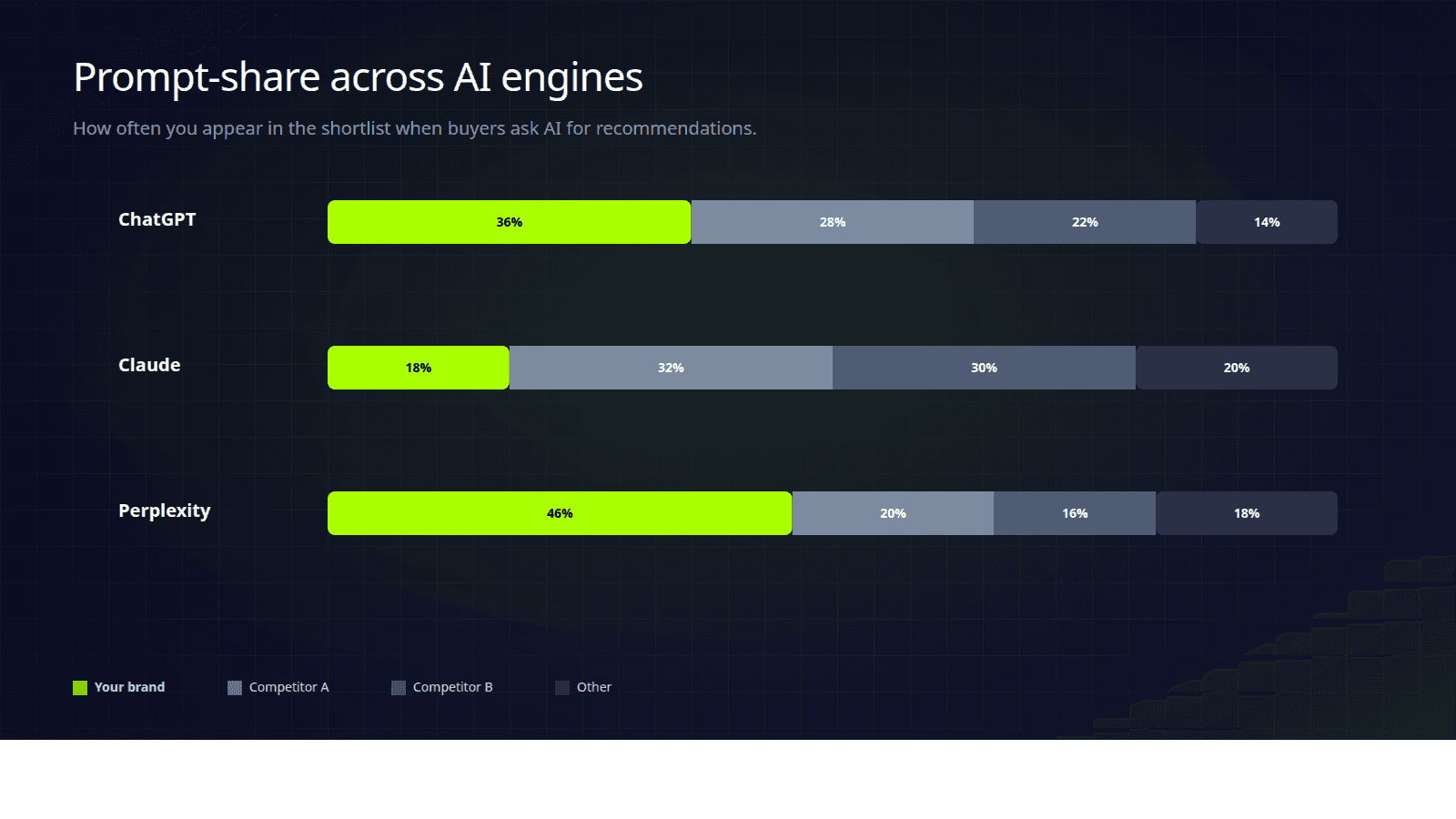
The durable advantage isn't patchwork internal automation. It's external legibility, that comes from customers who had a seamless experience thanks to the internal automation and presenting that narrative and proof points to AI platforms. It's how well your company, product and people are understood by the AI systems that now mediate trust.
You can have the world's best automated invoice processing and still be invisible when someone asks an LLM to recommend a vendor in your space. The back office matters. The front-of-the-model matters more. This is uncomfortable for many marketing teams, because GEO isn't really a marketing job in the traditional sense. It's closer to product marketing, technical writing, structured data engineering and PR welded together. It's making sure your company exists clearly enough, in enough places, in enough machine-parseable ways, that no generative engine on Earth would describe you as generic.
Brand still matters for generative AI visibility ... just differently
Some takes on the future of search with AI responses swing too hard and conclude that brand is dead. It isn't. It's just doing a different job.
Human memory becomes more valuable in the interpretation economy, not less. Here's why: people often ask AI for things by name. They prompt: "Compare HubSpot and Salesforce." They don't usually prompt: "Tell me about every CRM in existence and rank them." Whichever brand has lodged itself in the buyer's head as a candidate gets included in the comparison. Whichever brand hasn't, doesn't.
Strong human-facing brand work is what gets you into the prompt. Strong GEO is what gets you out of the response favourably. You need both. The marketer who can run a memorable launch campaign on a Tuesday and ship a structured, schema-rich, comparison-confident product page on a Wednesday is the marketer who wins the next decade. Historically these have been different people in different departments, often actively suspicious of each other. That ends now. Generative Engine Optimisation forces brand and product marketing into the same room.
What to actually do to improve GEO Performance
If you're a founder, marketer or operator reading this and feeling itchy, here's the practical version.
Audit how you appear to AI today. Open Claude, ChatGPT and Perplexity. Ask each to describe your company. Ask each to recommend the best three tools or providers for your category. Notice whether you appear at all, whether you're described accurately, and whether you sound like yourself or like the category average. Ten minutes; the single most clarifying Generative Engine Optimisation exercise I know.
Then make yourself harder to flatten. Rewrite your homepage so the first paragraph would be useful to a generative engine answering a buyer's query, who you are, who you're for, what you do, what makes you different, in plain specific language. Publish what you've been avoiding: pricing, named customers, head-to-head comparisons, your actual ideal customer profile, the use cases you're not good at. Add structured data. Get cited in the third-party sources generative engines actually reach for.
Be specific. Be opinionated. Be provable.
The attention economy rewarded those who could be the loudest. The interpretation economy rewards those who can be the clearest. Generative Engine Optimisation is the discipline that translates clarity into pipeline. GEO is a quieter game than traditional SEO ever was, no satisfying rank-tracking dashboard, no Friday-afternoon traffic spike to celebrate, but the stakes are exactly the same. Do you exist, in the eyes of the buyer, or don't you?
Build your Truth Map. Make yourself legible to the generative engines. Or accept being category wallpaper.
At Generativ, we work with SMBs and scaling B2B businesses on exactly this split, and we've been deliberate about not bundling the two disciplines into a single fuzzy offer.
If buyers in your category are using AI to build shortlists and you're not on them, that's a GEO problem. We help you fix it: audit how the major generative engines describe you today, build the Truth Map underneath your site, ship the structured proof, comparison content and citation surfaces that get you cited rather than averaged out, and track your prompt-share over time.
If you want to know where you actually stand:
- Book a free GEO audit: we'll show you exactly how Claude, ChatGPT, Perplexity and Gemini describe your business today, where you appear in category shortlists, and the three highest-leverage moves to fix it. Get in touch →